Discovery of Altjira: Potential Three-Body System Sheds Light on Kuiper Belt Mysteries
March 4, 2025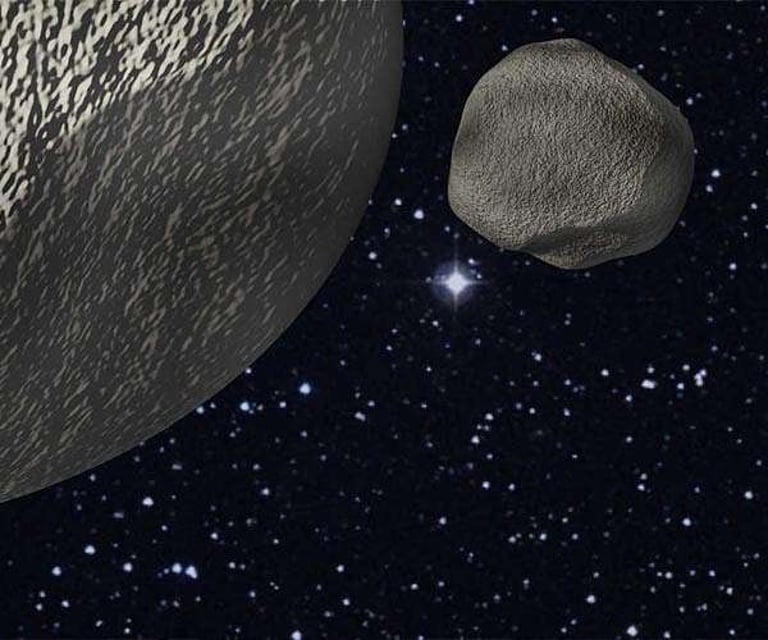

Darin Ragozzine, a co-author from Brigham Young University, highlighted that the change in the outer object's orbit orientation aligns with the hypothesis of a triple system when analyzed with Hubble data.
Altjira is significantly larger than previously studied Kuiper Belt objects, measuring approximately 124 miles wide, making it ten times larger than Arrokoth, which is a known contact binary.
Researchers have tracked the Altjira system for 17 years, collecting observational data that indicates the unique co-orbital motion of its components, suggesting the possibility of a triple system.
Prior to this finding, only about 40 binary objects had been identified in the Kuiper Belt, and the potential for triples like Altjira indicates a larger, yet-undiscovered population may exist.
The findings from Hubble reinforce the theory that Kuiper Belt objects form through processes akin to star formation, which typically results in pairs or triples.
NASA's Hubble Space Telescope and the W. M. Keck Observatory have discovered a potential three-body system in the Kuiper Belt, named the Altjira system, located approximately 3.7 billion miles from Earth.
As Altjira enters an eclipsing period over the next decade, this unique phase will allow for enhanced observations, particularly by NASA's James Webb Space Telescope.
This discovery suggests that the Altjira system may represent a stable trio of icy bodies, supporting the theory that such formations arise from gravitational collapse rather than collisions.
Kuiper Belt objects, first identified in 1992, are remnants from the early solar system, with over 3,000 cataloged and estimates suggesting hundreds of thousands more await discovery.
The James Webb Space Telescope is expected to provide additional insights into whether the components of Altjira share similar characteristics, enhancing our understanding of this intriguing system.
The inner object of the Altjira system may consist of two bodies that are indistinguishable at such vast distances, or it could be a contact binary or an elongated shape, necessitating further observations to confirm its nature.
Summary based on 3 sources
Get a daily email with more Science stories
Sources

ScienceDaily • Mar 4, 2025
NASA's Hubble finds Kuiper Belt duo may be trio
NASA Science • Mar 4, 2025
NASA’s Hubble Finds Kuiper Belt Duo May Be Trio