DESI Findings Challenge Cosmology: Dark Energy May Not Be Constant, New Models Needed
March 19, 2025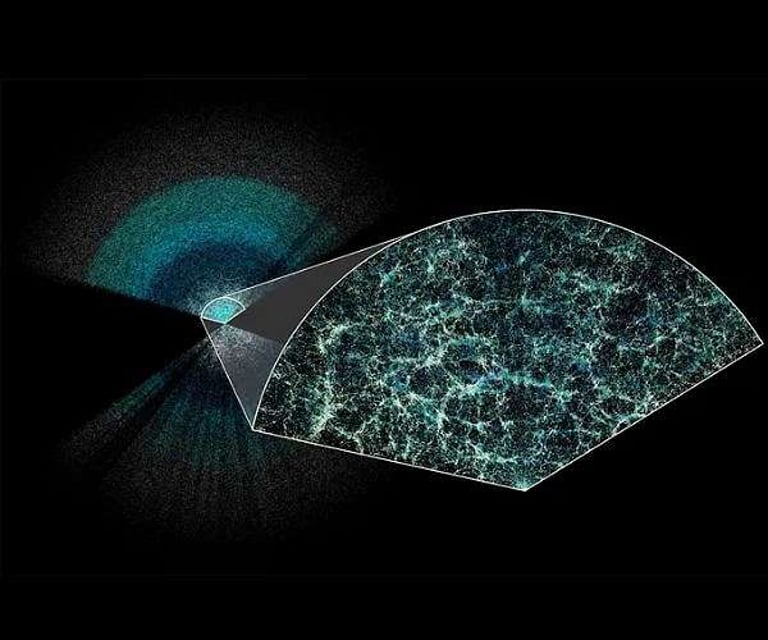


The quantum technology sector has seen significant growth, generating over $1.4 billion in revenue in 2024, with more than $1 billion coming from quantum computing alone.
Recent findings from the Dark Energy Spectroscopic Instrument (DESI) suggest that dark energy, which drives the universe's accelerating expansion, may not be constant but rather evolving.
Mustapha Ishak, a cosmologist from the University of Texas at Dallas, described these findings as 'game-changing' for cosmology, indicating that the universe may not expand indefinitely and could potentially re-collapse.
The DESI project, based at Kitt Peak National Observatory in Arizona, has released data from over 14 million galaxies spanning 11 billion years, marking a significant advancement in our understanding of cosmic evolution.
Researchers involved in the DESI project, including physicist Nathalie Palanque-Delabrouille, have increased confidence in their findings, suggesting that no overlooked factors are influencing the results.
With a goal to map around 50 million galaxies and quasars by 2026, the collaboration is part of a broader effort that includes other initiatives like the European Space Agency's Euclid mission, which also investigates dark energy.
In another scientific breakthrough, researchers at Oregon State University have developed a new magnetic nanoparticle that targets ovarian tumors and can be heated to kill cancer cells, showing promising results in mice.
These results challenge the standard model of cosmology, which has dominated scientific thought for about 25 years, prompting a reevaluation of fundamental concepts.
In a related development, health officials in Texas have warned that a measles outbreak could persist for up to a year, highlighting ongoing public health concerns.
However, the rapid increase in satellite launches, particularly from SpaceX's Starlink, has raised concerns among astronomers regarding satellite pollution that interferes with astronomical observations.
Meanwhile, astronauts Butch Wilmore and Suni Williams have returned to Earth after a nine-month stay on the International Space Station, joined by NASA astronaut Nick Hague and Russian cosmonaut Aleksandr Gorbunov.
As the scientific community continues to explore these advancements, the implications for our understanding of the universe and public health remain significant.
Summary based on 39 sources
Get a daily email with more World News stories
Sources

The New York Times • Mar 19, 2025
Astronomers Get ‘More Than a Hint’ That Dark Energy Isn’t What They Thought
The Guardian • Mar 19, 2025
Is dark energy destined to dominate the universe and lead to the ‘big crunch’?
The Guardian • Mar 19, 2025
Dark energy: mysterious cosmic force appears to be weakening, say scientists
BBC News • Mar 19, 2025
Dark Energy experiment shakes Einstein's theory of Universe