Rice University Scientists Achieve Decades-Old Quantum Breakthrough with Superradiant Phase Transition Observation
April 14, 2025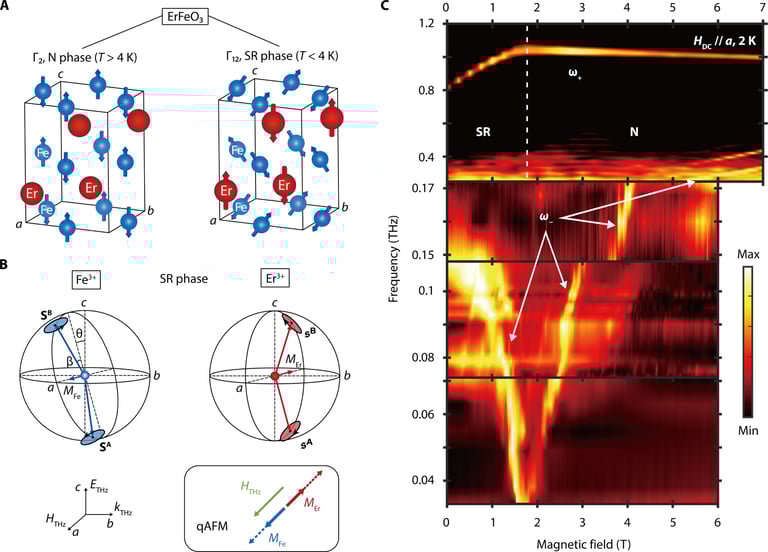

The experiment utilized a crystal composed of erbium, iron, and oxygen, which was cooled to minus 457°F and subjected to a magnetic field of 7 tesla, significantly stronger than Earth's magnetic field.
The SRPT occurs when two groups of quantum particles fluctuate in a coordinated manner without external triggers, resulting in a new state of matter.
This transition was induced through spin interactions rather than light, overcoming a known theoretical limitation, and was confirmed through precise spectroscopic measurements.
Researchers at Rice University have made a groundbreaking discovery by directly observing a superradiant phase transition (SRPT), a quantum phenomenon that has been predicted for over 50 years.
Lead author Dasom Kim explained that this observation was achieved by coupling two distinct magnetic subsystems of spin fluctuations from iron and erbium ions within a crystal.
Advanced spectroscopic techniques revealed clear spectral signatures of the SRPT, aligning with theoretical predictions and confirming the existence of this new state.
The findings not only validate a long-standing prediction in physics but also suggest further exploration of quantum phenomena in materials with similar magnetic interactions.
The research indicates that concepts from quantum optics can now be applied to solid materials, allowing for new methods to create and control phases of matter.
Near the quantum critical point of the transition, the system stabilizes quantum-squeezed states, drastically reducing quantum noise and improving measurement precision.
This discovery has significant implications for quantum technologies, potentially enhancing ultra-sensitive sensors and high-fidelity quantum computing by enabling access to exotic collective quantum states.
The study was supported by various organizations, including the U.S. Army Research Office and the National Science Foundation, showcasing the collaborative effort behind this research.
Sohail Dasgupta, a graduate student involved in the project, emphasized the importance of matching theoretical models with experimental data, a rare achievement in the field.
Summary based on 2 sources
Get a daily email with more Science stories
Sources
Phys.org • Apr 14, 2025
Scientists observe exotic quantum phase once thought impossible
The Quantum Insider • Apr 13, 2025
Scientists Observe Exotic Quantum Phase Once Thought Impossible