Revolutionary Paste-Like Battery Promises Flexible, Eco-Friendly Power for Next-Gen Devices
April 17, 2025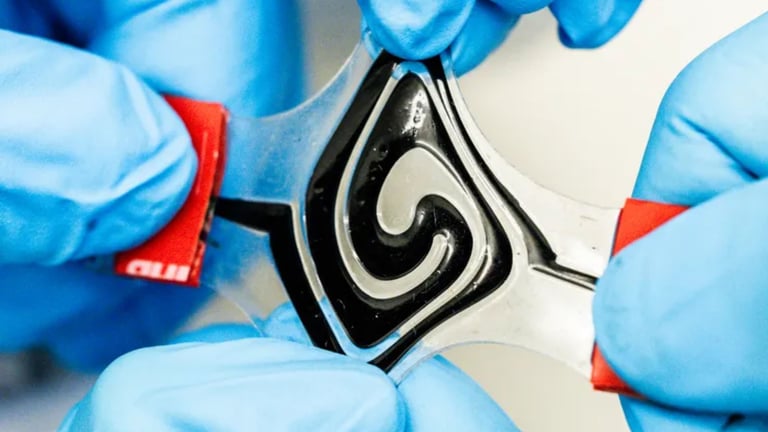


Researchers from Linköping University in Sweden have developed a groundbreaking battery technology that resembles a paste, allowing for flexible shaping and molding.
This innovative approach utilizes liquid electrodes made from conductive plastics and lignin, a sustainable byproduct of paper production, overcoming limitations of previous attempts that relied on rigid mechanical features.
The new battery can be manufactured in various shapes, potentially using 3D printing, which opens up new design possibilities for battery-powered devices.
Such flexibility could lead to innovative applications in next-generation devices, including wearable technology, foldable phones, and medical devices like pacemakers.
Demonstrating impressive durability, the battery can stretch up to twice its length and endure over 500 charging cycles without performance loss.
However, the current voltage of this new battery is limited to 0.9 volts, which is lower than standard AA batteries and typical smartphone batteries.
To address this limitation, researchers are exploring alternative chemical compounds, including zinc and manganese, to enhance the battery's voltage in future iterations.
Co-author Aiman Rahmanudin highlighted that this soft and flexible battery technology eliminates traditional design constraints, enabling seamless integration into various electronic devices.
The use of abundant and sustainable materials contributes to a more environmentally friendly model in battery production, as noted by lead author Mohsen Mohammadi.
This breakthrough could revolutionize the design and functionality of future battery-powered devices, offering unprecedented design flexibility.
The study detailing this innovation, titled 'Make it flow from solid to liquid: Redox-active electrofluids for intrinsically stretchable batteries,' was published in Science Advances on April 11, 2025.
Previous efforts to use liquid electrodes, such as gallium, were unsuccessful due to environmental concerns and their inability to function effectively during charging cycles.
Summary based on 3 sources
Get a daily email with more Tech stories
Sources
Gizmodo • Apr 14, 2025
Researchers Develop a Soft Battery That Has the Consistency of Toothpaste
Pocket-lint • Apr 17, 2025
This new toothpaste battery tech might revolutionize the charging industry