Breakthrough Coronagraph Enhances Exoplanet Detection, Paving Way for Discovery of Habitable Earth-like Worlds
April 21, 2025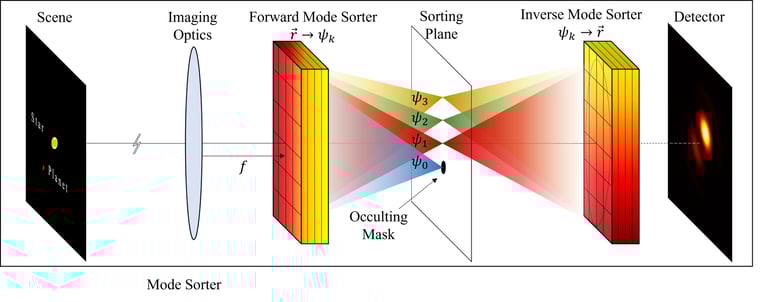

Researchers have developed an innovative coronagraph that effectively blocks light from bright stars, enabling the detection of distant exoplanets that current telescopes struggle to resolve.
Nico Deshler, the research team leader from the University of Arizona, highlights the challenge of detecting faint exoplanets that are often overwhelmed by the brightness of their host stars.
This new coronagraph employs a spatial mode sorter to isolate light from the star, allowing for the capture of images of off-axis exoplanets, much like isolating different acoustic frequencies from a piano.
In testing, the coronagraph achieved a remarkable contrast ratio of 1000:1 between a simulated star and an exoplanet, successfully estimating the position of the exoplanet.
Current efforts are focused on enhancing the mode sorter to minimize crosstalk, which can interfere with image quality, particularly at the extreme contrast levels necessary for exoplanet studies.
Compared to previous coronagraph designs, this new device promises to provide more detailed information about sub-diffraction exoplanets, potentially aiding in the detection of biosignatures.
The coronagraph could reveal Earth-like planets located in the habitable zone, which are often up to a billion times dimmer than their stars, making them extremely difficult to detect.
This proof-of-principle experiment may pave the way for new optical pre-processing methods in astronomical instrumentation, with potential applications extending to quantum sensing and medical imaging.
The research aligns with NASA's Habitable Worlds Observatory, which is dedicated to advancing exoplanet science and has inspired various coronagraph designs with different performance trade-offs.
Directly imaging exoplanets is particularly challenging due to their proximity to bright stars and the significant brightness differences, making this coronagraph's capabilities especially valuable.
The coronagraph demonstrates the ability to achieve the fundamental limits of exoplanet detection and localization as defined by quantum optics, capturing images with enhanced resolution.
By revealing Earth-like planets in habitable zones, this device could provide crucial insights into the potential for life beyond Earth.
Summary based on 2 sources
Get a daily email with more Science stories
Sources

ScienceDaily • Apr 18, 2025
Turning down starlight to spot new exoplanets
Phys.org • Apr 21, 2025
Turning down starlight to spot new exoplanets