Breakthrough: Stable Carbene Observed in Water for the First Time, Paving Way for Greener Chemistry
April 22, 2025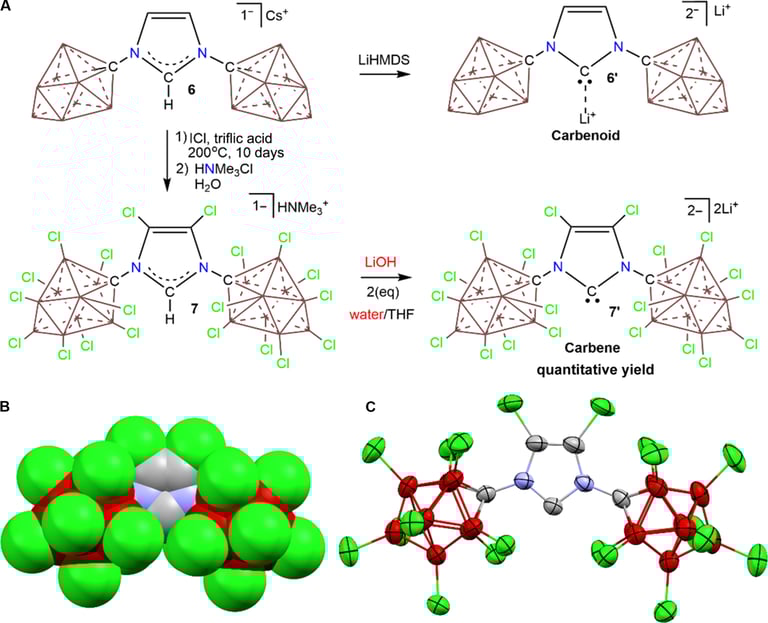

Vincent Lavallo and his team at UC Riverside have made a groundbreaking discovery by successfully generating and isolating a stable carbene in water, a feat previously deemed impossible.
This achievement confirms a 67-year-old hypothesis proposed by Ronald Breslow, which suggested that vitamin B1 could form a carbene to facilitate essential biochemical reactions.
Published in Science Advances on April 21, 2025, this research not only solves a long-standing biochemical mystery but also opens the door to greener pharmaceutical manufacturing methods.
The ability to stabilize carbenes in water has significant implications for pharmaceutical production, as these reactive intermediates can serve as ligands in metal-based catalysts, potentially making processes cleaner and safer.
Utilizing water as a solvent aligns with the principles of greener chemistry, given its abundance and non-toxic nature, which could reduce reliance on harmful organic solvents.
This discovery enhances our understanding of natural cellular chemistry, which predominantly occurs in aqueous environments, by allowing researchers to generate and study reactive intermediates in water.
The stable carbene can be analyzed using advanced techniques such as nuclear magnetic resonance spectroscopy and X-ray crystallography, providing robust evidence of its existence.
Lavallo expressed the personal significance of this achievement, reflecting on the evolution of carbene research over the past three decades.
Varun Raviprolu, the study's first author, emphasized that perseverance in scientific research can turn seemingly impossible ideas into reality, reinforcing the need for continued investment in science.
This discovery serves as a motivational reminder of the potential for breakthroughs in scientific research to transform our understanding and capabilities.
The research not only supports Breslow's hypothesis but also brings researchers closer to mimicking the complex chemistry that occurs naturally within cells.
Carbenes, characterized by their instability due to having only six valence electrons, are typically highly reactive and decompose rapidly in water, making this discovery particularly remarkable.
Summary based on 3 sources
Get a daily email with more Science stories
Sources

ScienceDaily • Apr 21, 2025
Scientists finally confirm vitamin B1 hypothesis from 1958
Phys.org • Apr 21, 2025
Scientists finally confirm vitamin B1 hypothesis from 1958