Mysterious Cosmic Object ASKAP J1832-0911 Baffles Astronomers with Unique Radio and X-ray Emissions
May 28, 2025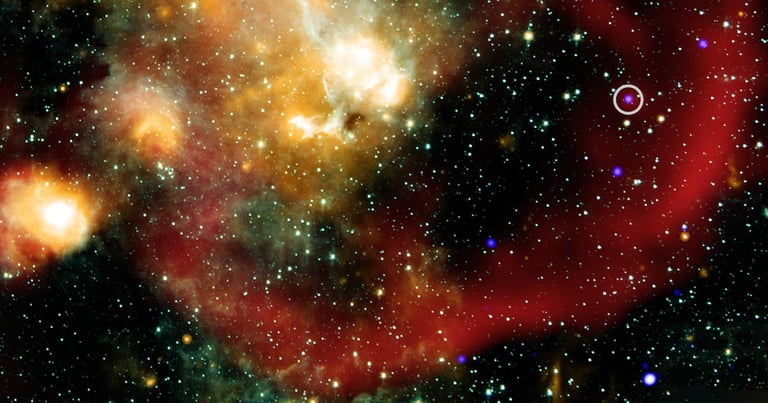

The X-ray emissions detected by NASA's Chandra X-ray Observatory suggest significant events within the object, as X-rays typically originate from extremely hot and energetic environments.
Unlike traditional pulsars that emit radio signals at much shorter intervals, this object operates at intervals of minutes or hours, raising questions about its underlying mechanisms.
The research involved collaboration across multiple countries, utilizing data from various telescopes to confirm the repeating nature of the object's emissions.
Located approximately 15,000 light-years away in a densely populated region of the Milky Way, ASKAP J1832-0911's relationship with a nearby supernova remnant remains uncertain due to its unknown distance.
The discovery hints at the possibility of many more similar objects in the universe, which could enhance our understanding of their enigmatic characteristics.
Lead author Dr. Ziteng Andy Wang noted that the object may be a highly magnetized dead star, such as a neutron star or white dwarf, or possibly an unknown exotic object.
Currently, there is no known explanation for how the signals from this object are generated or why they activate and deactivate at such regular intervals.
ASKAP J1832-0911 appears to be located within a supernova remnant, but researchers believe this is coincidental and the two are not associated.
The discovery of X-ray emissions from ASKAP J1832-0911 was unexpected and likened to 'finding a needle in a haystack' due to the observational constraints of telescopes like Chandra and ASKAP.
Co-author Dr. Nanda Rea indicated that the transient is likely not a magnetar, despite its location within a supernova remnant, and may instead represent a white dwarf with an unusually strong magnetic field.
Over a six-month period, the star's X-ray and radio emissions displayed dramatic changes, an unprecedented phenomenon within the Milky Way.
Astronomers have identified a new cosmic object, ASKAP J1832-0911, first detected by the Australian Square Kilometre Array Pathfinder in December 2023, which emits both radio waves and X-rays in a unique 44-minute cycle.
Summary based on 21 sources
Get a daily email with more Science stories
Sources
Forbes • May 28, 2025
44-Minute Pulse From Mystery Star Baffles Scientists — What To Know
Yahoo News • May 28, 2025
Astronomers discover strange new celestial object in our Milky Way galaxy

The Independent • May 28, 2025
Something is flashing at us from space – and scientists have no idea what it is