Revolutionary DNA Microflow Breakthrough: Remote-Controlled Movements via Light-Responsive Condensates Unveiled
June 23, 2025

A research team from the Institute of Science Tokyo, led by Professor Masahiro Takinoue and Assistant Professor Hirotake Udono, has made a groundbreaking advancement in remote-controlled microflow using light-responsive DNA condensates.
Their findings, published in Nature Communications on May 14, 2025, detail a novel method for achieving mechanical actions in DNA structures, a feat not previously accomplished in similar research.
This innovative approach allows for the creation of mechanical actions in DNA-based micro-assemblies, which opens new avenues for applications in diagnostics and molecular computing.
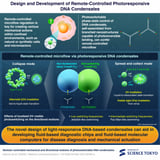
The study utilized photoresponsive DNA liquid condensates featuring azobenzene, enabling DNA motifs to dissociate or reassemble in response to ultraviolet (UV) and visible light.
Experiments demonstrated multiple mechanical action modes, including an outward spread of condensates under UV light and a gel-to-liquid state transition, showcasing the versatility of these DNA structures.
The DNA condensates exhibited unique directional motions, mimicking jellyfish swimming at lower light switching frequencies and a Pac-Man-like movement at higher frequencies, indicating potential for robotic actuation.
To facilitate these mechanical actions, a non-photoresponsive DNA motif was crosslinked to the photoresponsive structure, enabling the generation of microflows.
The implications of this research are significant, paving the way for advanced applications in fluid-based diagnostic chips and molecular computers, highlighting the potential of remote-controlled DNA-based micro-assemblies.
The researchers created 'Y'-shaped nanostructures by self-assembling single-stranded DNA strands with azobenzene integrated into their terminal ends, enhancing their photo-responsiveness.
By alternating UV and visible light, the researchers showcased a 'spread and collect' mode, demonstrating the condensate's ability to undergo reversible phase transitions.
This study marks a significant breakthrough in the field, as it introduces a method for achieving mechanical actions in DNA structures that had previously eluded researchers.
The potential applications of this technology are vast, with prospects for innovative developments in diagnostics and molecular computing.
Summary based on 3 sources
Get a daily email with more Science stories
Sources
Phys.org • Jun 23, 2025
Photo-switchable DNA condensates enable remote-controlled microflow systems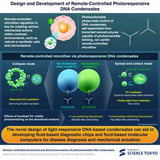
EurekAlert! • Jun 23, 2025
Novel DNA-based assemblies for the development of remote-controlled microsystems
Mirage News • Jun 23, 2025
New DNA Assemblies Power Remote-Controlled Microsystems