James Webb Telescope Captures Smallest Exoplanet Yet, Unveiling TWA 7b's Secrets
June 25, 2025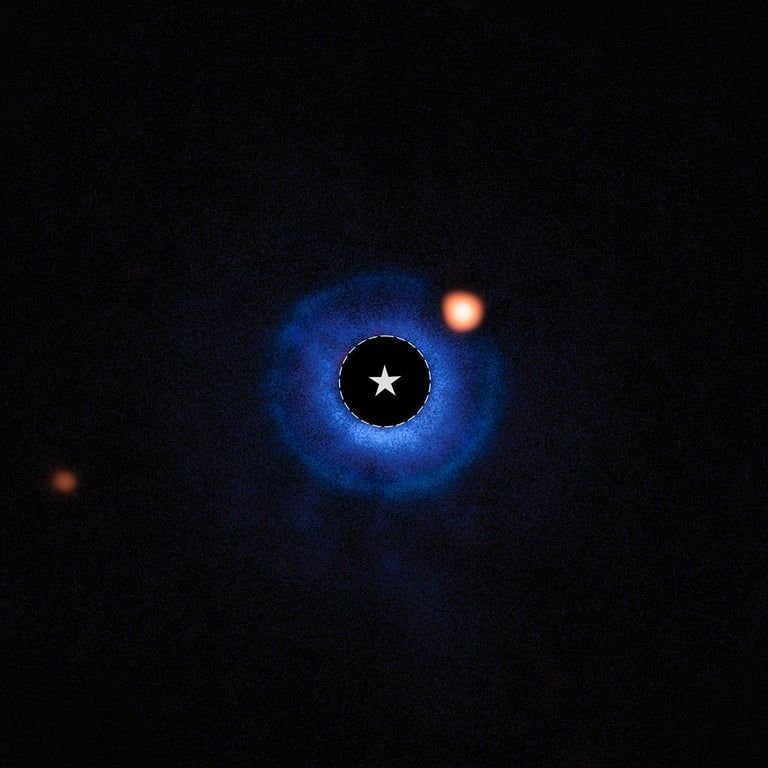


The James Webb Space Telescope (JWST) has successfully imaged its first new exoplanet, TWA 7b, located approximately 111 light-years from Earth and comparable in mass to Saturn.
Remarkably, TWA 7b is ten times smaller than any previously observed exoplanet, making its direct observation a significant achievement, as smaller planets are often obscured by the light of their host stars.
Analysis indicates that TWA 7b has a mass about 0.3 times that of Jupiter, roughly equivalent to 100 Earth masses, and a temperature around 320 Kelvin (47 degrees Celsius).
This groundbreaking discovery was made by a collaborative team from France’s National Centre for Scientific Research (CNRS), Observatoire de Paris-PSL, and Université Grenoble Alpes.
Dr. Anne-Marie Lagrange, an astrophysicist involved in the discovery, highlighted the focus on young stars and the strategy of searching for gaps in debris disks where exoplanets might be hidden.
The JWST's ability to directly image low-mass planets was enhanced by its coronagraph, which blocks out the light from central stars, allowing astronomers to detect faint infrared emissions from orbiting exoplanets.
This finding marks the first confirmation of a planet in a debris disk using JWST's Mid-Infrared Instrument (MIRI), showcasing the telescope's advanced observational capabilities.
The presence of TWA 7b helps explain the gaps in the protoplanetary disk around its host star, indicating interactions between the planet and the disk material during early planetary formation.
Researchers are now aiming to locate even lighter exoplanets, potentially leading to discoveries of rocky planets similar to Earth and Mars, which are prime targets for habitability studies.
The results of this discovery were published in the journal Nature on June 25, 2025, emphasizing the significance of imaging such a light planet.
This discovery not only enhances our understanding of planetary systems but also paves the way for identifying other similar exoplanets using JWST.
The observations are part of Webb's ongoing program aimed at exploring low-mass planets and improving our understanding of planet formation and debris disk evolution.
Summary based on 11 sources
Get a daily email with more World News stories
Sources

The Guardian • Jun 25, 2025
James Webb telescope captures direct images of Saturn-sized exoplanet
Forbes • Jun 25, 2025
Webb Telescope Images New Planet — What It Means For Earth 2.0 Search
New York Post • Jun 25, 2025
James Webb Space Telescope discovers its first exoplanet as stunning image is revealed
Gizmodo • Jun 25, 2025
Webb Telescope Just Did Something It’s Never Done Before—and Astronomers Are Thrilled