NASA's Europa Clipper Achieves Milestone with Successful Mars Flyby Radar Test
August 4, 2025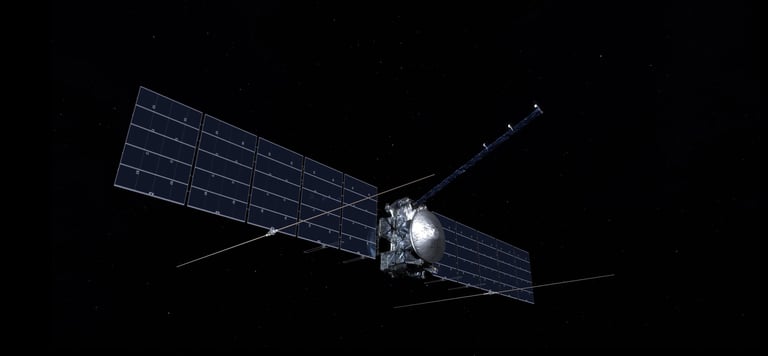

NASA's Europa Clipper spacecraft successfully tested its REASON radar instrument during a flyby of Mars in early March 2025, collecting critical data for its upcoming mission to Europa, a moon of Jupiter.
This flyby utilized Mars' gravity for trajectory adjustments while allowing the spacecraft to calibrate its instruments, including the radar, over familiar Martian terrain.
The REASON radar operated effectively at altitudes ranging from 3,100 miles to 550 miles above Mars, transmitting and receiving data for approximately 40 minutes and collecting a total of 60 gigabytes of information.
The successful test results generated excitement among engineers and scientists, who are now preparing to analyze the data to assess the instrument's performance against existing models.
Managed by NASA's Jet Propulsion Laboratory, the mission involves collaboration with several institutions, including the Johns Hopkins Applied Physics Laboratory and the University of Texas at Austin.
Don Blankenship, the principal investigator from the University of Texas at Austin, expressed satisfaction with the radar's performance, noting that it met all expectations during the Mars flyby.
NASA's Jet Propulsion Laboratory oversaw the spacecraft's assembly and testing, although a larger chamber was needed for full radar tests that could not be accommodated on-site.
The Europa Clipper mission, launched in October 2024, is set to travel about 1.8 billion miles to study Jupiter and its moons, with a planned arrival in the Jupiter system expected in 2030.
Prior to its launch, extensive testing of the radar was conducted in clean rooms and open-air towers, but the Mars flyby provided a crucial opportunity for real-world calibration.
During the flyby, the REASON radar transmitted radio waves for about 40 minutes, collecting 60 gigabytes of data, which has thrilled scientists eager to analyze the results.
Results from the radar test indicate it will perform well at Europa, where it will operate at much closer distances, potentially as low as 16 miles from the surface.
The REASON radar is designed to penetrate Europa's icy shell to detect subsurface water and analyze the moon's geological features, contributing to the mission's goal of studying its astrobiological potential.
Summary based on 5 sources
Get a daily email with more Science stories
Sources
NASA • Aug 1, 2025
NASA’s Europa Clipper Radar Instrument Proves Itself at Mars - NASA
ScienceDaily • Aug 4, 2025
Radar that could find life on Europa just nailed its first big test
Phys.org • Aug 4, 2025
NASA's Europa clipper radar instrument proves itself at Mars
The Register • Aug 4, 2025
Mars says hello as NASA's Europa Clipper warms up radar