JWST's TRAPPIST-1 e Study: A Quest to Unveil the Exoplanet's Mysterious Atmosphere
September 8, 2025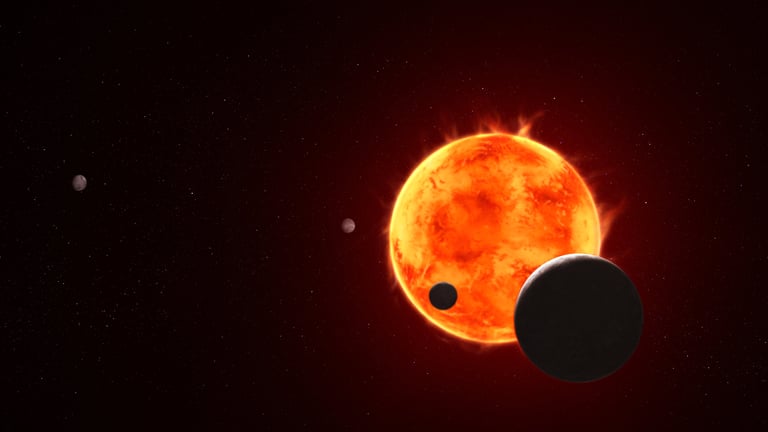

NASA's James Webb Space Telescope is studying the exoplanet TRAPPIST-1 e, which orbits within its star's habitable zone, where liquid water could potentially exist if the planet has an atmosphere.
Initial findings are inconclusive due to contamination from the star's magnetic activity, but they suggest either TRAPPIST-1 e has a secondary atmosphere with gases like nitrogen or it is a bare rock with no atmosphere.
Further observations with JWST are planned to improve data quality, aiming to determine more definitively whether the planet has an atmosphere by analyzing additional transits to clarify its chemical composition.
The data analysis faced challenges because of extensive contamination from starspots caused by the red dwarf star's magnetic activity, requiring significant correction.
Scientists had to develop new models to distinguish atmospheric signals from the star's light, marking a significant step forward given the complexity of readings from a red dwarf star.
Initial observations in 2023 revealed difficulties due to stellar activity, complicating the detection of the planet's atmosphere and highlighting the challenges of such measurements.
This research was published in The Astrophysical Journal Letters on September 8, representing a major advancement in the search for extraterrestrial life.
The JWST began its science operations in July 2022, with competitive proposal selection focusing on planetary systems and the origins of life.
Experts emphasize that atmospheric composition is crucial for habitability, with a nitrogen/oxygen-rich atmosphere potentially indicating life-supporting conditions.
The research is part of the JWST-TST DREAMS program, involving over 30 scientists from the UK, US, and India, aimed at better understanding exoplanet atmospheres and habitability.
TRAPPIST-1 e could have surface conditions like a global ocean or ice-covered areas, and is likely tidally locked, with one side constantly facing its star.
Scientists used JWST’s Near-Infrared Spectrograph to analyze starlight passing through the planet's atmosphere during transits, searching for chemical signatures.
Spectroscopic data from four transits suggest the planet lacks a thick primordial atmosphere and that stellar flaring has affected the spectra, complicating analysis.
Summary based on 7 sources
Get a daily email with more Science stories
Sources

New Scientist • Sep 8, 2025
Exoplanet 40 light years from Earth may have right conditions for life
NASA Science • Sep 8, 2025
NASA Webb Looks at Earth-Sized, Habitable-Zone Exoplanet TRAPPIST-1 e - NASA Science