2025 Nobel Prize in Physics Honors Pioneers of Quantum Superconducting Circuits, Revolutionizing Quantum Technology
October 9, 2025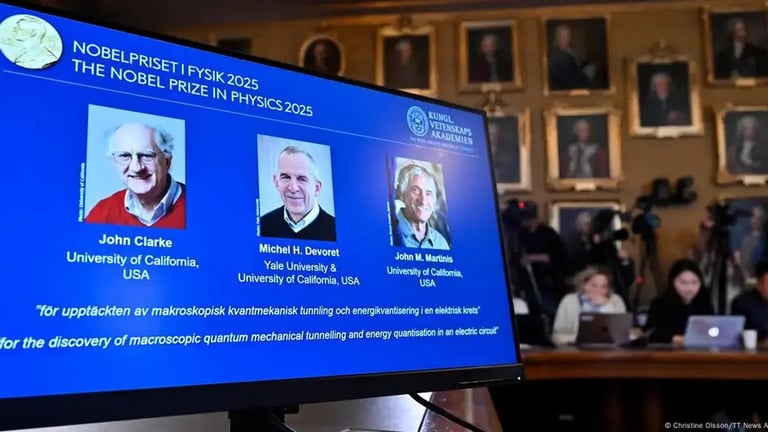

The 2025 Nobel Prize in Physics was awarded to John Clarke, Michel Devoret, and John Martinis for their groundbreaking work demonstrating quantum effects in large superconducting circuits, which has significantly advanced practical quantum technologies.
Their research has had a lasting impact on quantum science, contributing to the development of quantum computers and influencing ongoing research efforts led by figures like Martinis at Google and others in the field.
The laureates' work, which began in the 1980s, focused on superconducting circuits, particularly Josephson junctions, revealing that these circuits could exhibit quantum phenomena such as energy quantization and superposition.
Ilana Wisby, a quantum physicist and former CEO of Oxford Quantum Circuits, highlights the scientific and technological impact of their discoveries, emphasizing how they bridge fundamental physics with practical applications.
Ongoing efforts by academia and industry aim to improve superconducting qubits' coherence and scalability, with some projects targeting error-corrected quantum computers by 2028.
The foundational experiments in the 1980s demonstrated that superconducting circuits made from materials like niobium and lead could exhibit quantum behavior at near absolute zero, including quantized energy levels and superposition.
These experiments proved that quantum effects could be observed on a macroscopic scale, extending quantum phenomena beyond microscopic systems, and laid the groundwork for modern quantum computing.
John Clarke expressed surprise and pride in their collective achievement, recognizing that their work underpins everyday technologies like cellphones and is a major step toward practical quantum computers.
The Nobel Prize week also includes awards in medicine, chemistry, and literature, with the ceremony scheduled for December 10, where winners will share approximately €1.03 million.
Superconducting circuits are now widely used in quantum physics, sensing, and computing because they can be controlled reliably and scaled effectively, making them a cornerstone of modern quantum technology.
Research showed that these circuits behave as single quantum particles, demonstrating quantization, superposition, and entanglement—key properties that enable the power of quantum computing.
This groundbreaking work has profound implications for developing advanced quantum technologies like quantum cryptography, sensors, and large-scale quantum processors.
Summary based on 5 sources
Get a daily email with more Science stories
Sources
Physics World • Oct 9, 2025
From quantum curiosity to quantum computers: the 2025 Nobel Prize for Physics – Physics World
SlashGear • Oct 9, 2025
Quantum Mechanics Visionaries Take Home 2025's Physics Nobel Prize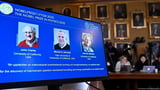
Frontline • Oct 9, 2025
Quantum Leap: Nobel Prize in Physics 2025 Honours Tunnelling Breakthrough