SOHO Celebrates 30 Years: Pioneering Solar Observations and Shaping Future Space Missions
December 2, 2025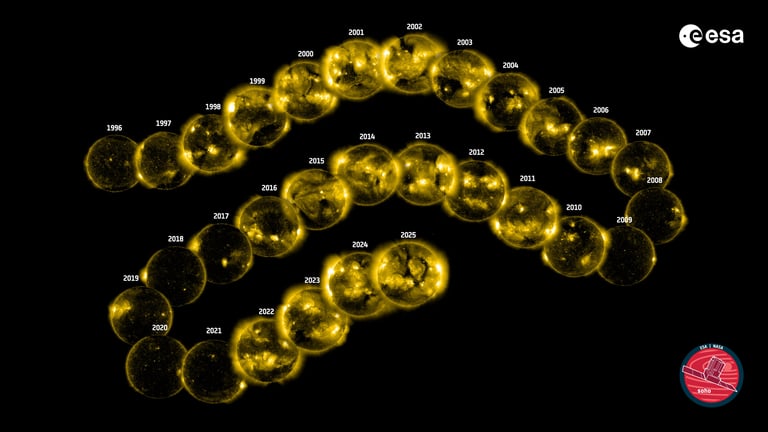

SOHO, launched in 1995, is a joint ESA/NASA solar observatory stationed about 1.5 million kilometers from Earth toward the Sun, and it has provided near-continuous solar data for nearly three solar cycles.
Its LASCO instrument helped establish real-time space weather monitoring, contributing to U.S. policy like the PROSWIFT Act to improve forecasting of solar storms that impact Earth.
Over its three decades, SOHO has tracked solar activity, including flares and coronal mass ejections, underpinning understanding of space weather and the Sun’s roughly 11-year cycle.
The story emphasizes NASA-ESA collaboration, the sun-Earth connection, and the ongoing importance of space weather research for future human and robotic exploration.
SOHO spurred future missions and programs, such as PUNCH and NOAA’s SWFO-L1, and influenced Artemis-era exploration plans.
ESA’s science chief highlights SOHO’s resilience and longevity with a celebratory note on its enduring significance as a landmark mission.
SOHO’s relevance persists, with expected long-term impact on solar science, data policies, and international collaboration, including multipoint solar studies and guiding new spacecraft.
The mission endured early setbacks, notably loss of contact in 1998 and gyroscope failures, but international effort and software updates kept it operating without gyros by 1999.
Despite challenges like the 1998 loss of contact and spinning issues, engineers recovered the spacecraft and continued operations beyond initial expectations.
Further resources offer more on SOHO and the Sun’s cycle, with Space.com’s content manager identified as Kenna Hughes-Castleberry.
SOHO’s legacy shaped later solar observatories and missions, including Solar Orbiter, SDO, Parker Solar Probe, Proba-3, and the Vigil mission, through advances in instrumentation, open data, and collaboration.
Long-term data show the Sun’s total energy output varies little across the solar cycle, while extreme ultraviolet radiation can double, influencing Earth’s upper atmosphere without driving surface climate trends.
Summary based on 4 sources
Get a daily email with more Science stories
Sources
Phys.org • Dec 2, 2025
Sun-watcher SOHO celebrates 30 years
Sun-watcher SOHO celebrates thirty years
Sun-watcher SOHO celebrates thirty years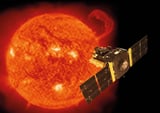
NASA Science • Dec 2, 2025
NASA, ESA Sun Observatory Marks 30 Years - NASA Science