Megaconstellations Threaten Space Telescope Data: Urgent Call for Global Coordination and Mitigation
December 3, 2025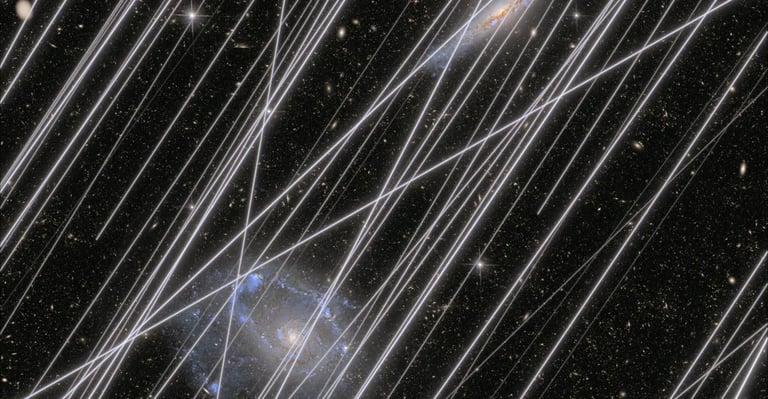

A new Nature study assesses how potential megaconstellations, possibly totaling hundreds of thousands of satellites, could create streaks and radio interference that degrade data from space-based telescopes like Hubble, SPHEREx, ARRAKIHS, and Xuntian.
Simulations indicate that near high satellite counts, the average number of satellite trails could be about two per Hubble image and roughly 90 per Xuntian image, due to differences in field of view and orbital height.
The study highlights mitigation as essential, calling for coordinated efforts in satellite design, orbital management, observation planning, and data-processing techniques to reduce photobombing.
Regulatory and political discussions emphasize global coordination, with ideas such as dark sky zones and binding ITU/UNOOSA guidelines to balance commercial deployment with preserving astronomical research.
Industry responses focus on shielding, better satellite design, and best practices to minimize optical and radio interference, alongside ongoing dialogue between operators like SpaceX and the scientific community.
Experts caution that impact depends on scientific goals; some observations can be mitigated by repeating or combining data, but irreversible losses are possible in certain cases.
Transparency from satellite operators about location, orientation, and color is urged to help mitigate contamination of observations.
Experts say the issue poses a significant challenge for the future of space-based astronomy and may require coordinated approaches across missions and operators to preserve observational capabilities.
There is an ongoing debate about balancing satellite broadband expansion with preserving astronomical observations, with different missions showing varying susceptibility and mitigation options.
The paper reinforces the inevitability of space-based optical interference from megaconstellations and notes the difficulty of fully mitigating effects without major changes to satellite design, operations, or observatory strategies.
Urgent call for scientists and policymakers to address satellite interference to preserve the quality and value of astronomical data from both ground- and space-based observatories.
Mitigation ideas include shorter exposure times to reduce streaks, though this requires pre-planned camera design and may not help already-launched missions.
Summary based on 15 sources
Get a daily email with more Science stories
Sources
The Verge • Dec 3, 2025
Satellites keep photobombing the Hubble telescope, and it’s getting worse
Yahoo News • Dec 3, 2025
NASA study shows how satellite 'light pollution' hinders space telescopes
Nature • Dec 3, 2025
Satellite swarms set to photobomb more than 95% of some telescopes’ images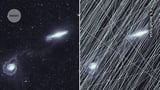
Nature • Dec 3, 2025
Even in space, telescopes can’t escape photobombers