Largest Nasal Microbiome Study Reveals Predictive Patterns for S. aureus Infection Risk
December 3, 2025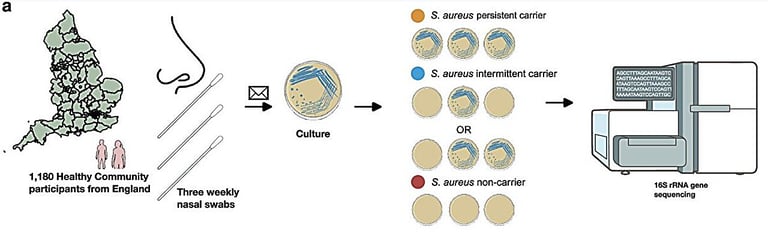

The research was conducted by the Wellcome Sanger Institute, University of Cambridge, Imperial College London, and collaborators, with volunteers recruited across England.
Findings point to predictive tools and microbiome-informed interventions to prevent S. aureus infections, particularly in hospital settings.
A distinctive carrier-associated microbiome shows higher S. aureus presence and lower overall diversity, while certain bacteria like Staphylococcus epidermidis, Dolosigranulum pigrum, and Moraxella catarrhalis are less common in persistent carriers and may resist colonization.
Clinically, microbiome-based strategies could reduce infection risk and improve pre-surgical screening and targeted decolonization, offering alternatives to antibiotic approaches.
In a large nasal microbiome study, researchers used three weekly nose swabs and advanced statistics to identify two major microbial patterns and showed that machine learning can predict persistent S. aureus carriage, enabling risk stratification for infection.
The study challenges the idea of intermittent carriage as a true biological state, suggesting it may reflect misclassification of persistent carriers or non-carriers rather than a distinct condition.
Future work will investigate how factors such as medical conditions, sex, human genetics, and environmental exposures shape S. aureus carriage and nasal microbiome interactions.
This represents the largest analysis to date of the nasal microbiome, highlighting that S. aureus operates within a broader bacterial community rather than in isolation.
Summary based on 3 sources
Get a daily email with more Science stories
Sources
Medical Xpress • Dec 2, 2025
Largest study of nose microbiome helps highlight those at risk of Staph aureus infection
Imperial College London • Dec 2, 2025
Largest study of nose microbiome helps highlight those at risk of Staph aureus infection
GEN - Genetic Engineering and Biotechnology News • Dec 3, 2025
Large Nasal Microbiome Study Links Low Diversity, Species Interactions to S. aureus Colonization