China's Bold Space Missions: Aiming for the Stars in 2026-2030 Five-Year Plan
December 8, 2025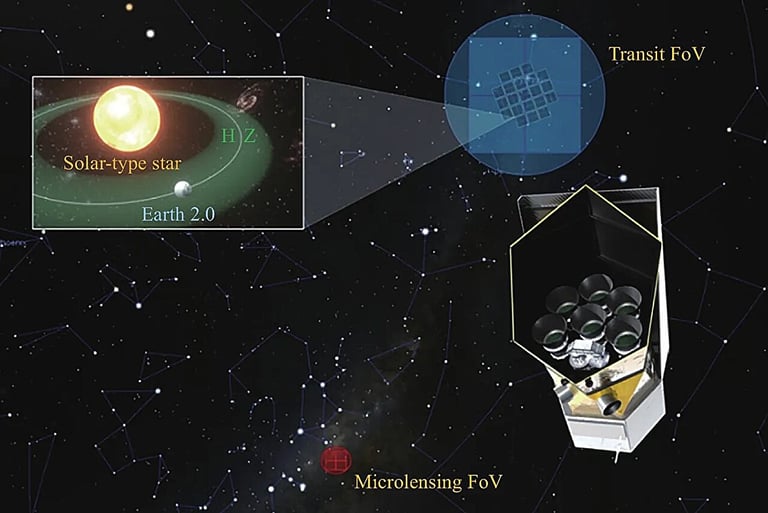

Hongmeng Project would deploy ten low-frequency lunar-orbiting telescopes behind the Moon to study the Universe’s early epochs and observe the Cosmic Dark Ages.
EXTP Space Observatory (eXTP) is a Chinese-led international mission that combines X-ray timing and polarimetry to explore extreme physics near black holes, neutron stars, and related energetic phenomena, targeting a 2030 launch.
The ambitions are framed within humanity’s place in the universe and the search for Earth-like planets, linking existential questions with scientific advancement.
China lays out four space missions in the 15th Five-Year Plan (2026-2030) to push space science, exploration, and research, signaling a strategic move to become a major space power.
CGTN frames these missions as part of a broader effort to lead in space science, research, and exploration, including radio astronomy, solar physics, exoplanet discovery, and high-energy astrophysics.
Kuafu-2 is a solar observatory designed to orbit the Sun’s polar regions to study the magnetic field and solar cycle dynamics, improving solar-storm predictions.
Exo-Earth (Earth 2.0) is an exoplanet surveyor aiming to find Earth-like planets by monitoring thousands of stars, with a planned launch around 2028.
Summary based on 2 sources