Revolutionary Light-Driven Polymerization Enables Safer, Scalable Organic Electronics for Wearable Tech and Medical Devices
December 16, 2025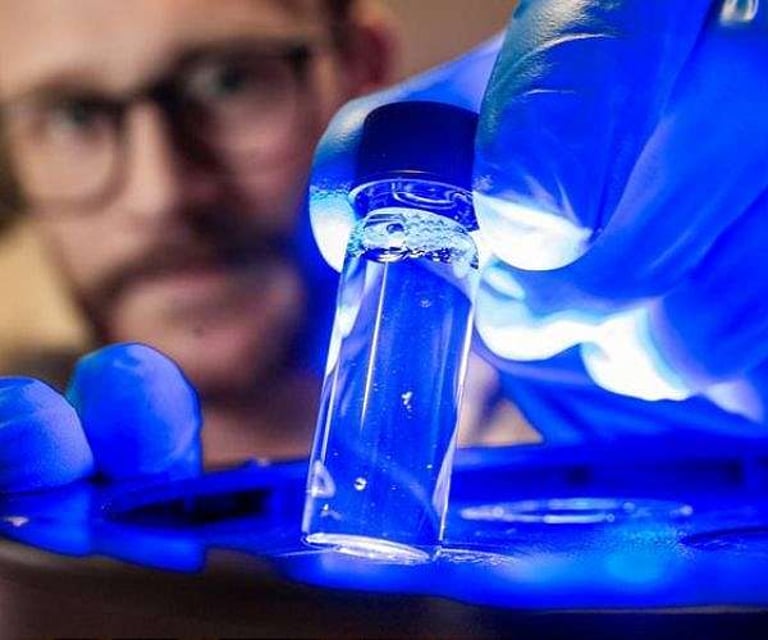

The work points to wearable sensors in garments and broader medical and renewable‑energy applications, enabled by solvent‑free processing.
The approach eliminates hazardous solvents, paving the way for large‑scale manufacturing of organic electronics and sensors integrated into garments or other surfaces.
The method uses simple light sources like LEDs and aqueous chemistry, suggesting potential for wearable sensors and scalable organic circuits on diverse surfaces.
The resulting material is an organic mixed conductor that carries both electrons and ions, enabling direct interfacing with biological systems and enhanced tissue compatibility.
The process uses aqueous chemistry and avoids toxic reagents, making the fabrication safer and more scalable than traditional polymer electrode methods.
The study appears in Angewandte Chemie, credited to Tobias Abrahamsson et al., under the title Visible-Light-Driven Aqueous Polymerization Enables in Situ Formation of Biocompatible, High-Performance Organic Mixed Conductors for Bioelectronics.
In vivo tests patterned electrodes onto anesthetized mice skin, showing improved low‑frequency brain activity recordings versus traditional metal EEG electrodes.
A new study from top European universities demonstrates a light‑driven method to polymerize water‑soluble monomers using visible light, yielding conductive plastic electrodes without hazardous solvents or UV exposure.
Water-soluble monomers polymerize under visible light, eliminating the need for strong/toxic reagents and ultraviolet exposure.
Researchers highlight broad potential for medical devices, diagnostics, and wearable tech thanks to the method’s simplicity and surface‑level versatility.
Electrodes can be formed directly on glass, textiles, and skin, enabling flexible, surface‑localized electronics and biocompatible sensors.
Summary based on 3 sources
Get a daily email with more Science stories
Sources

ScienceDaily • Dec 15, 2025
Light-printed electrodes turn skin and clothing into sensors
Phys.org • Dec 15, 2025
Light-driven process forms flexible electrodes on skin, textiles and glass