Breakthrough Transparent Nanowire Films Offer High EMI Shielding for Flexible Electronics
December 21, 2025


A Glasgow team has created ultra-thin, transparent nanowire films that block electromagnetic interference without sacrificing lightness or optical clarity, addressing the long-standing trade-off between conductivity and transparency.
Potential applications span wearable and implantable health monitoring devices, flexible displays, and other electronics that require high-performance EMI shielding with optical transparency.
The process fuses laser engineering with electric-field-guided nanoscale assembly to create precise, programmable patterns directly on bendable substrates, with potential for scalable manufacturing beyond cleanrooms.
Overall, the method aims to overcome the conventional trade-off between conductivity and transparency in metallic nanowire networks, enabling broader use in flexible electronics.
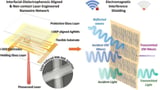
The network features capacitive nanogaps that form a capacitive, interwire network, suppressing external EM interference while preserving transparency.
Led by Jungang Zhang at the University of Glasgow’s meLAB, the researchers used a laser-engineered interfacial-dielectrophoresis (i-DEP) method to align silver nanowires on flexible polyimide substrates, forming novel EMI-shielding films that remain see-through.
A second ultrafast step uses picosecond laser pulses to weld nanowire junctions and strip insulating surface layers, yielding about a 46-fold drop in electrical resistance and up to a 10% gain in transparency.
In detail, the ultrafast laser bonding reduces contact resistance between wires, removes insulating coatings, and increases optical transmission by roughly ten percent.
The method enables larger-area films—demonstrated at 40 by 80 centimeters—suggesting scalable production of flexible, transparent EMI shields beyond small wafers.
This approach supports shielding for flexible, implantable, or bendable devices without bulky metal layers and can be scaled to large-area films.
Prototype films achieve over 99.97% shielding of electromagnetic radiation across 2.2–6 GHz (Wi‑Fi and 5G bands) while remaining about 83% transparent and only 5.1 micrometers thick.
The activity confirms a shielding effectiveness exceeding 35 dB in the same frequency range, with the ultra-thin film maintaining substantial optical transparency.
Summary based on 2 sources
Get a daily email with more Tech stories
Sources
Phys.org • Dec 19, 2025
Laser-engineered nanowire networks could unlock new material manufacturing
Interesting Engineering • Dec 21, 2025
Ultra-thin nanowire films block over 99% of wireless signals without metal