Spectacular Mud Eruption at Yellowstone's Black Diamond Pool Captured by New Monitoring System
December 21, 2025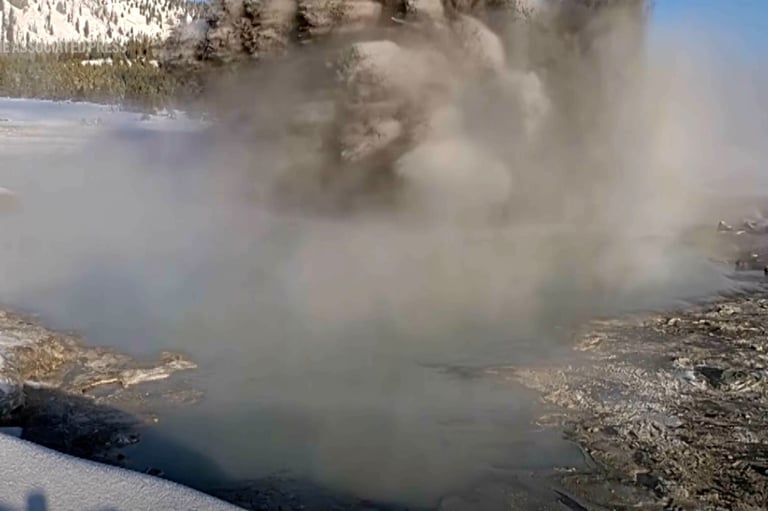


Yellowstone Volcano Observatory footage from its webcam shows mud spraying from the pool as part of ongoing dirty eruptions that have reached similar heights since 2024.
Park Geology Program researchers installed a new camera, seismic/acoustic monitoring station, and temperature sensors this summer to improve detection and characterization of eruptions.
In sum, enhanced monitoring installed in the summer strengthens the park’s ability to observe these hydrothermal events.
Officials note Yellowstone’s vast hydrothermal system, with more than 10,000 features and over 500 geysers, underscoring the park’s dynamic and hazardous geology.
A muddy eruption, described as a dirty eruption, erupted from Black Diamond Pool in Yellowstone National Park on Saturday morning, with mud spraying from the pool around 9:23 a.m. in Biscuit Basin between Old Faithful and Grand Prismatic.
Park officials emphasize the extensive and diverse hydrothermal features—over 10,000 features and more than 500 geysers—highlighting Yellowstone’s unique geology and continued activity.
Experts say there is no discernible pattern or precursors to these eruptions at Black Diamond Pool, indicating unpredictable and sporadic activity.
The Yellowstone Volcano Observatory webcam at Black Diamond Pool offered a clear view of the eruption under wintery, snowy conditions, illustrating ongoing activity.
USGS volcanic experts described the event with the exclamation “Kablooey!” and shared video of the eruption on social media.
The site previously experienced a July 2024 hydrothermal explosion that sent rocks and mud high, damaged a boardwalk, and led to area closures due to hazards, with dirty eruptions continuing since then.
Since 2024, dirty eruptions at Black Diamond Pool have intermittently reached up to about 40 feet (12 meters).
The new camera, seismic/acoustic station, and temperature sensors provide more reliable observation and help scientists better detect and characterize these eruptions.
Summary based on 4 sources
Get a daily email with more World News stories
Sources

AP News • Dec 21, 2025
Kablooey! Volcanic experts capture muddy eruption at Yellowstone | AP News
Phys.org • Dec 21, 2025
Muddy eruption at Yellowstone's Black Diamond Pool captured on video
FOX 5 San Diego & KUSI News • Dec 21, 2025
Muddy eruption at Yellowstone’s Black Diamond Pool captured on video
Queen City News • Dec 21, 2025
Muddy eruption at Yellowstone’s Black Diamond Pool captured on video