Newly Discovered Ushikuvirus Sheds Light on Evolution of Eukaryotic Life and Giant Viruses
January 7, 2026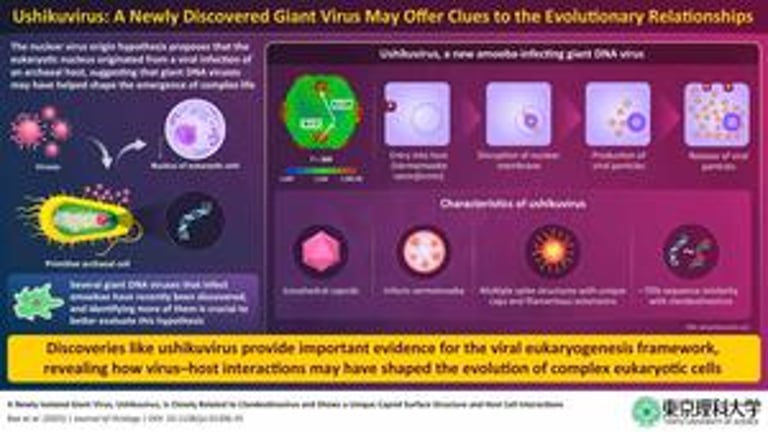

A new giant virus named ushikuvirus has been discovered in vermamoeba, linked to the Mamonoviridae family, reinforcing the idea that large DNA viruses played a role in the origin of eukaryotic nuclei.
It also provides broader insight into the diversity and evolution of giant viruses, showing how variations in host interaction and replication strategies reflect adaptations to different hosts.
Using 3D cryo-electron microscopy, researchers detailed ushikuvirus’s icosahedral capsid and surface spikes, revealing a complex structure and attachment mechanisms.
Unlike some relatives, ushikuvirus disrupts the host’s nuclear membrane and builds its own replication factories, exiting the cell gradually via exocytosis rather than lysing the host.
The virus was isolated near Lake Ushiku in Ibaraki Prefecture, Japan, and was reported online in the Journal of Virology on November 24, 2025 by Prof. Masaharu Takemura and collaborators from Tokyo University of Science and the National Institute of Natural Sciences.
Published in the Journal of Virology in late 2025, led by Professor Masaharu Takemura, the study implies that giant viruses like ushikuvirus could illuminate the evolution and phylogeny of giant virus families and eukaryotic origins.
Beyond theory, understanding such giant viruses could inform approaches to control related amoebal infections in humans and shed light on how viruses may be integrated into the tree of life rather than acting solely as parasites.
The discovery helps map the diversification of giant viruses and their interactions with hosts, contributing to our understanding of the evolution of complex eukaryotic life.
The research team includes Jiwan Bae, Narumi Hantori, Dr. Raymond Burton-Smith, and Professor Kazuyoshi Murata, with funding from Japanese research grants.
Funding for the work came from JSPS/KAKENHI and the ExCELLS program, with the team aiming to further explore giant virus biology and its implications for understanding life’s origins.
The findings underscore Tokyo University of Science’s research prominence and highlight the ongoing significance of environmental giant viruses in mapping life’s evolutionary history.
The study notes that giant viruses are widespread yet challenging to isolate, with ushikuvirus offering a valuable comparative example to study diversification and co-evolution with hosts.
Summary based on 4 sources
Get a daily email with more Science stories
Sources

Phys.org • Jan 7, 2026
Ushikuvirus: Newly discovered giant virus may offer clues to the origin of life
Express.co.uk • Jan 7, 2026
Incredible giant virus linked to life’s origins discovered
EurekAlert! • Jan 7, 2026
Ushikuvirus: A newly discovered giant virus may offer clues to the origin of life
ScienceBlog.com • Jan 7, 2026
A Giant Virus From Japan Reignites a Radical Origin Story for Life