Hubble Captures Record-Breaking Protostellar Outflow from Massive Star IRAS 18162-2048
January 12, 2026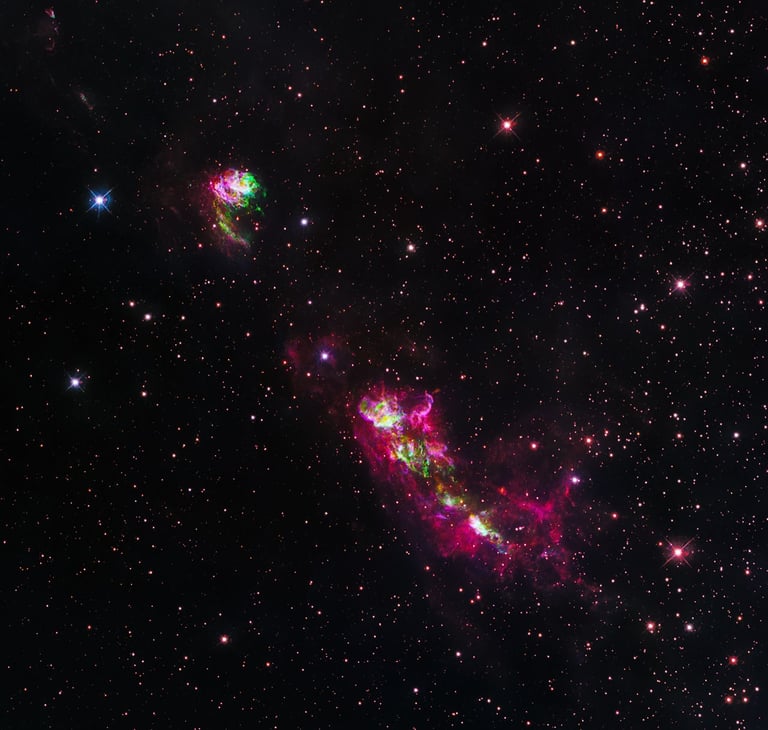

HH 80/81 are the largest known protostellar outflow, formed when fast jets from a massive young star collide with slower outflows, creating glowing shock-excited gas over an expansive 32 light-years.
NASA’s Hubble Space Telescope captured an image of the forming star IRAS 18162-2048’s jet, illuminating HH 80/81 as bright pink and green patches against space.
This jet stands out for being driven by a very massive young star rather than a low-mass source, marking a notable case among observed HH jets.
Hubble’s Wide Field Camera 3 provided high sensitivity and resolution, revealing fine details, movements, and structural changes in the HH 80/81 system.
The WFC3 data enabled measurements of jet speeds above 1,000 km/s, the fastest outflow observed in both radio and optical wavelengths for a young stellar object.
The image analysis highlights fast movements and evolving structure within the HH 80/81 features, thanks to Hubble’s capabilities.
IRAS 18162-2048 is a protostar roughly 20 solar masses, powering the luminous HH 80/81 pair and located in the L291 molecular cloud.
HH 80/81 lie about 5,500 light-years away in the Sagittarius constellation, offering a valuable view into massive-star formation and protostellar outflows.
The driving source is the massive protostar IRAS 18162-2048, the most massive protostar identified in the L291 molecular cloud.
Summary based on 2 sources
Get a daily email with more Science stories
Sources
Phys.org • Jan 12, 2026
Hubble spies stellar blast setting clouds ablaze
NASA Science • Jan 12, 2026
Hubble Spies Stellar Blast Setting Clouds Ablaze - NASA Science