JWST Unveils Stellar Nursery: Reveals 3,000 Stars and 'Failed' Brown Dwarfs in Westerlund 2
January 18, 2026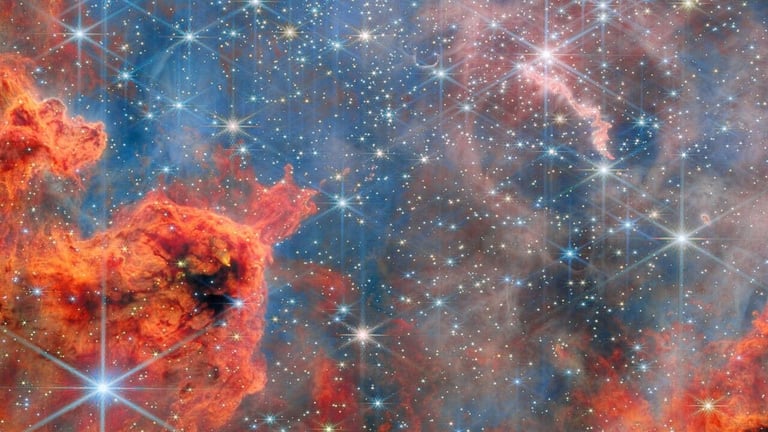

The James Webb Space Telescope has released a detailed infrared image of Westerlund 2, a compact star cluster about 20,000 light-years away in the Carina constellation, revealing roughly 3,000 stars in a nursery roughly 2 million years old.
Astronomers have identified a population of brown dwarfs—objects about ten times the mass of Jupiter—through infrared bands sensitive to methane and PAH emissions, highlighting ‘failed stars’ that never ignite sustained nuclear fusion.
The findings are documented in a report shared on December 19, 2025, produced by the European Space Agency in collaboration with NASA and the Canadian Space Agency, using data from JWST’s Near-Infrared Camera and Mid-Infrared Instrument.
This infrared view builds on Hubble’s 2015 imagery of Westerlund 2, offering a more vibrant portrait and providing new insights into star formation processes and the evolution of planet-forming disks around massive stars.
Westerlund 2 is a compact cluster spanning 6 to 13 light-years in diameter, home to some of the galaxy’s hottest and brightest massive stars, and serves as a site where ongoing star formation keeps nebular material heated and gives birth to new stars.
Summary based on 1 source
Get a daily email with more Science stories
Source
Live Science • Jan 18, 2026
James Webb telescope spots 'failed stars' in a breathtaking cluster near Earth — Space photo of the week