Astronomers Discover 'Styrofoam' Exoplanets Orbiting Young Star V1298 Tau
January 18, 2026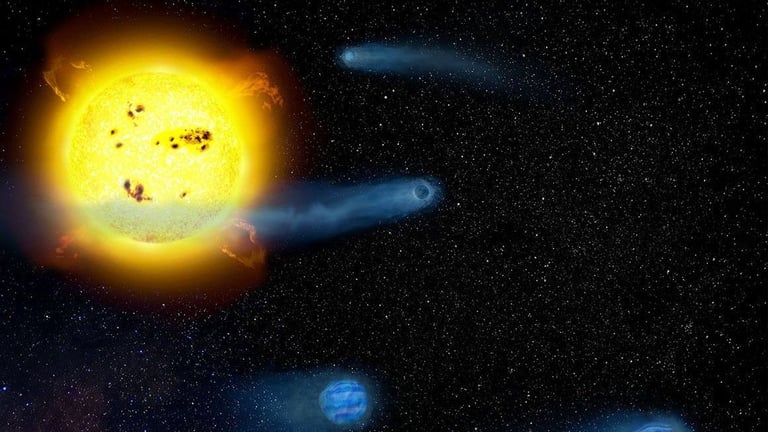

Astronomers have identified four young exoplanets orbiting V1298 Tau, a star about 350 light-years away and roughly 20 million years old, offering a rare glimpse into early planetary formation with unusually low densities.
These planets are extremely puffy, with densities akin to Styrofoam, indicating thick primordial atmospheres that are expected to erode over time, shrinking to become super-Earths and sub-Neptunes.
The findings, published in Nature on January 7, provide a direct observational snapshot of early planetary evolution and help constrain how common planetary architectures form.
Determining the orbital period of the outer planet V1298 Tau e required a third transit detected by the Las Cumbres Observatory network, resolving previous uncertainties and enabling full dynamical modeling.
The system is tightly packed, with one planet roughly Jupiter-sized and the other three ranging between Neptune- and Saturn-sized, a configuration rare among known systems aside from Kepler-51.
A decade-long campaign using transit timing variations across space- and ground-based telescopes measured planetary masses, enabling density estimates despite stellar activity.
Scientists expect these planets to lose substantial atmospheres and contract over billions of years, contributing to the population of compact super-Earths and sub-Neptunes observed in the galaxy.
Summary based on 1 source
Get a daily email with more Science stories
Source
Live Science • Jan 18, 2026
Strange discovery offers 'missing link' in planet formation: 'This fundamentally changes how we think…