Gravitational Lensing of Supernovae Sheds Light on Universe's Expansion and Dark Energy
January 19, 2026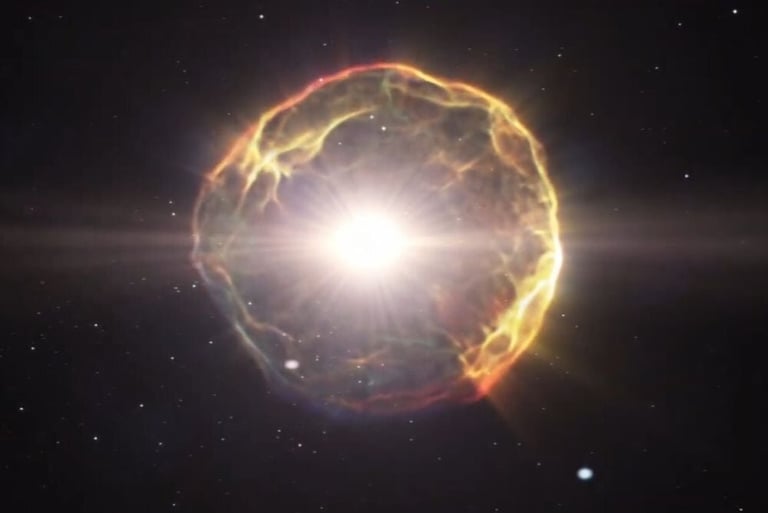

Billions of light-years away, the SNe are magnified and split into multiple images by strong gravitational lensing from intervening galaxy clusters, with SN Ares and SN Athena creating time-delayed light paths that enable cosmological measurements.
Researchers suggest these events could yield the most precise, single-step measurements of cosmology, potentially revealing new physics or uncovering unknown systematics in current analyses.
Scientists hope the measurements will provide precise, single-step constraints on cosmological parameters, informing whether current analyses are complete and whether new physics or unaccounted systematics are at play.
Discovered by the JWST VENUS program, the lensed pair SN Ares and SN Athena could help resolve the Hubble tension by delivering independent measurements of the Hubble Constant.
This work treats gravitational lensing by galaxy clusters as a natural telescope, with time-domain astronomy at its core to study the distant Universe.
Overall, findings presented at the AAS247 meeting show that gravitational lensing of distant supernovae could become a key, independent probe of the universe’s expansion rate and physics.
SN Ares exploded when the Universe was about 4 billion years old and SN Athena about 6.5 billion years ago; their time delays will illuminate dark energy, which dominates roughly 70% of the cosmos.
The VENUS program uses deep JWST observations of about 60 rich galaxy clusters to find rare distant sources, including lensed SNe, ancient stars, and active black holes.
VENUS aims to uncover rare distant phenomena by targeting 60 rich galaxy clusters, leveraging strong lensing to study early-universe sources and transient events.
Time-domain astronomy, as illustrated by these lensed SNe, tracks objects that change over years to decades due to cosmic scales, adding complexity and opportunity in measurements.
Time delays between multiple images arise from the combination of gravitational lensing and cosmic expansion, providing a natural experimental handle on the expansion history and the Hubble Constant.
The next images offer a long baseline: Athena’s reappearances are expected in a few years, while Ares’ reappearances occur about six decades later, enabling time-delay measurements across decades.
Summary based on 2 sources
Get a daily email with more Science stories
Sources
Phys.org • Jan 19, 2026
These gravitationally lensed supernovae could resolve the Hubble tension