Positronium Achieves Quantum Milestone: First Matter-Wave Diffraction Observed with Graphene Target
January 19, 2026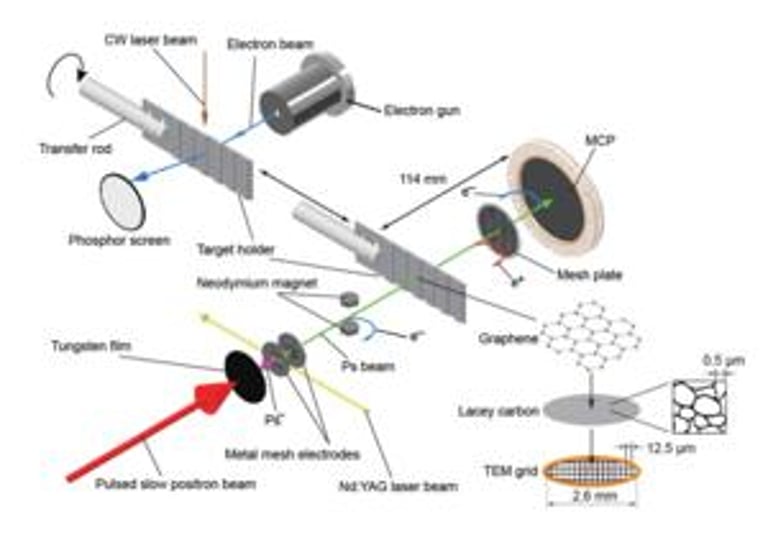

A landmark experiment from Tokyo University of Science, led by Prof. Yasuyuki Nagashima and colleagues, used a high-quality, tunable positronium beam and a graphene target to observe clear diffraction patterns, confirming that positronium interferes as a single quantum object.
Positronium, a bound state of an electron and a positron, exhibited matter-wave diffraction for the first time, showing interference as a single quantum object rather than separate electron and positron components.
Graphene acted as the diffraction grating, with atomic spacing matched to positronium’s de Broglie wavelength, enabling transmission and detection of clear interference fringes on a position-sensitive detector.
Researchers generated a fast, neutral, coherent positronium beam by creating negatively charged positronium ions and using a precise laser pulse to remove an extra electron, achieving energies up to 3.3 keV with a narrow energy spread.
Beyond fundamental interest, the work points toward non-destructive, surface-sensitive material analysis and future high-sensitivity tests of gravity with antimatter using positronium.
Future avenues include precision gravity tests with antimatter and other fundamental physics studies leveraging positronium as a simple, neutral atomic system.
Potential applications include analyzing insulating and magnetic surfaces non-destructively, using positronium diffraction to probe material properties.
The study was published in Nature Communications on December 23, 2025, by Y. Nagata and collaborators, with DOI 10.1038/s41467-025-67920-0.
Background and funding details, including information about Tokyo University of Science and COI statements, accompany the published work.
The approach advances positronium beam quality by increasing energy, tightening energy spread, and controlling beam direction, while maintaining ultra-high vacuum to keep the graphene surface clean for diffraction observations.
Overall, the results demonstrate that positronium interferes as a single quantum object, marking a major step in fundamental physics and enabling potential applications in precision measurements and material analysis.
The research team includes Professor Yasuyuki Nagashima, Associate Professor Yugo Nagata, and Dr. Riki Mikami, and the work was published by Tokyo University of Science.
Summary based on 2 sources
Get a daily email with more Science stories
Sources
Phys.org • Jan 19, 2026
Observing the positronium beam as a quantum matter wave for the first time
EurekAlert! • Jan 19, 2026
Observing positronium beam as a quantum matter wave for the first time