New Fossil Find in Ethiopia Reveals Paranthropus' Northern Expansion and Ecological Adaptability
January 21, 2026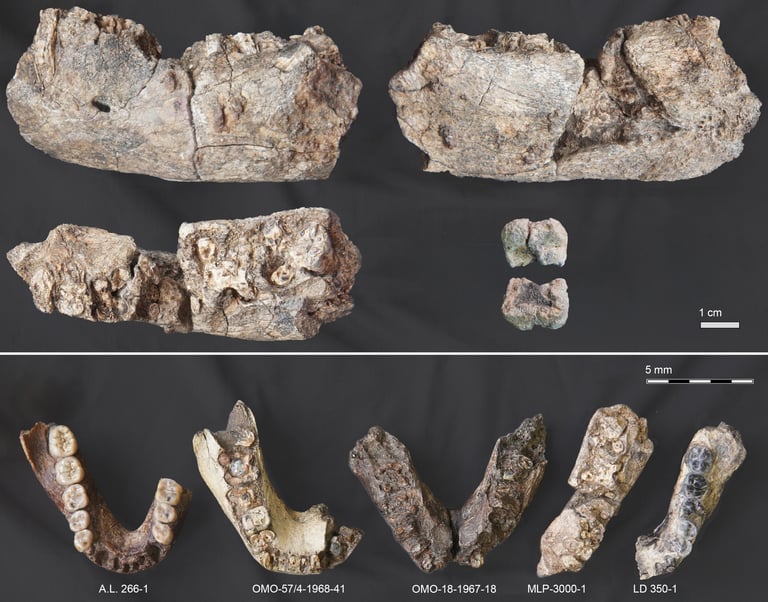

The finding prompts reevaluation of hominin biogeography, adaptation, and competition, potentially reshaping understanding of Paranthropus' evolutionary trajectory and its relation to Homo.
Experts note this discovery highlights the complexity of early hominin niches and the need to revise how key differences among early groups are understood.
The Mille-Logya find places Paranthropus within a diverse hominin mix in the Afar (~2.8 to 2.5 million years ago), prompting questions about interactions with Australopithecus and early Homo.
A new fossil discovery at Mille-Logya in the Afar region of northeast Ethiopia extends the known range of Paranthropus, showing they inhabited more northern and varied environments than previously thought.
The find supports the idea that Paranthropus could adapt to grassland expansion by shifting diet toward grasses and other resources, indicating ecological versatility beyond a fixed woody-habitat model.
This discovery sheds light on Paranthropus' environmental adaptation, broader geographic distribution, and possible interactions with other hominins, including Homo.
Researchers led by Zeresenay Alemseged used micro-CT scanning to analyze the partial jaw and internal morphology, blending field recovery with advanced imaging.
The study appears in Nature (2026) with DOI 10.1038/s41586-025-09826-x, authored by Alemseged and colleagues.
The jaw specimen, designated MLP-3000, comes from an older individual and shows dental and bone traits consistent with Paranthropus, the so-called robust hominins.
The wider dispersal of Paranthropus suggests multiple hominin lineages coexisted, supporting a mosaic view of human evolution rather than a single linear progression.
There are indications Paranthropus may have used simple stone tools, along with evidence of a highly dexterous hand, suggesting greater tool-use capability than previously recognized.
A 2.6-million-year-old lower jawbone and accompanying molar crown affirm the specimen as Paranthropus, likely P. aethiopicus or P. boisei, making it among the oldest Paranthropus remains.
Summary based on 3 sources
Get a daily email with more Science stories
Sources
Phys.org • Jan 21, 2026
2.6-million-year-old Paranthropus fossil expands early hominin range
New Scientist • Jan 20, 2026
Ape-like hominin Paranthropus was more adaptable than we thought
Live Science • Jan 21, 2026
2.6 million-year-old jaw from extinct 'Nutcracker Man' is found where we didn't expect it