Massive Sodium Nanoparticle Clusters Demonstrate Quantum Superposition, Defying Classical Physics
January 21, 2026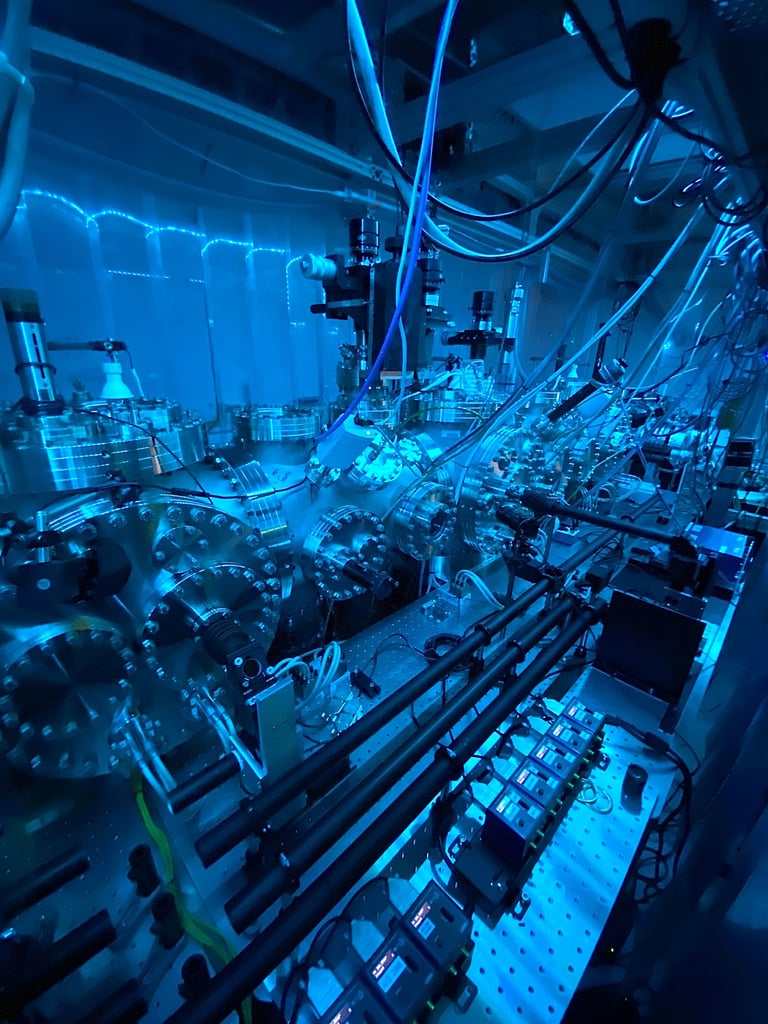

The macroscopicity metric reaches 15.5, about ten times higher than previous tests, indicating a robust test of quantum mechanics on large scales.
The clusters behave as waves and produce a detectable interference pattern, marking a larger object in a quantum superposition than previously achieved.
The Vienna apparatus functions as a highly sensitive force sensor, highlighting practical precision measurement capabilities for isolated nanoparticles.
Researchers from Vienna and Duisburg-Essen demonstrate quantum interference with massive sodium nanoparticle clusters, containing 5,000 to 10,000 atoms, showing wave-like behavior on a macroscopic scale.
The Vienna team created a giant quantum superposition with roughly 7,000 sodium atoms, about 8 nanometers across, placed into a spatial superposition separated by 133 nanometers.
The experiment uses a three-grating near-field interferometer with period-precise localization to generate a superposition of paths and produce a striped interference pattern in agreement with quantum theory.
Conducted at cryogenic conditions (77 K) in ultra-high vacuum, the MUSCLE setup employs UV diffraction gratings to observe coherent matter waves from high-mass clusters with short de Broglie wavelengths.
Key parameters include cluster masses around 100–200 kDa in initial scans, de Broglie wavelengths of 10–22 fm, fringe visibility, grating spacing, and detection via photodepletion and ionization sampling.
Nanoparticles are about 8 nanometers in diameter and exceed 170,000 atomic mass units, displaying interference when traversing three UV laser gratings.
The results align with quantum predictions rather than classical moiré explanations, strengthening evidence for quantum superposition in massive objects.
The results are discussed in the broader quantum-to-classical transition debate, touching on Schrödinger’s cat and macrorealist ideas, with prospects for higher-mass and alternative-material tests.
The study points toward a platform for interferometry with even larger masses and materials, hinting at tests of fundamental physics and potential enhancements like a vertical interferometer to increase macroscopicity.
Summary based on 5 sources
Get a daily email with more Science stories
Sources
Nature • Jan 21, 2026
Probing quantum mechanics with nanoparticle matter-wave interferometry

Newswise • Jan 21, 2026
Metal Clumps in Quantum State: Vienna Research Team Breaks Records | Newswise