James Webb Telescope Unveils Sharper Dark Matter Map, Illuminates Cosmic Origins
January 26, 2026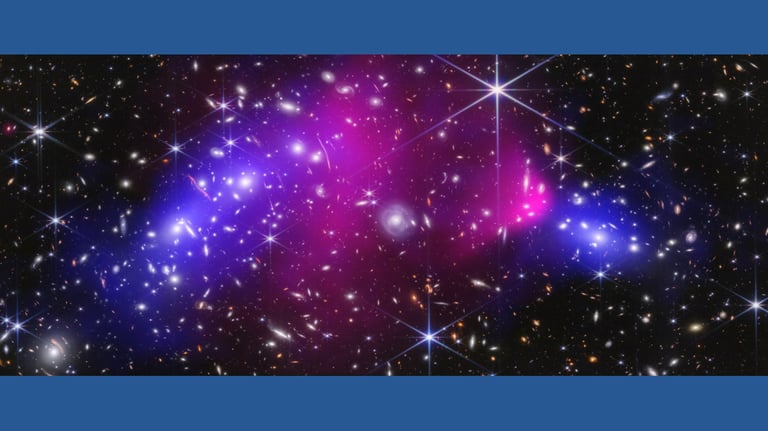


Key researchers, including Diana Scognamiglio of NASA’s JPL and Rutuparna Das of the Harvard-Smithsonian Center for Astrophysics, stress dark matter’s central role in understanding cosmic origins.
The COSMOS region near Sextans was the focus, with implications for tracing galaxy growth and evolution through time.
Webb contributed about 255 hours in the first year of operations, marking the largest survey to date and enabling cross-checks with earlier Hubble COSMOS data for consistency and new features.
The study uses the COSMOS field and gravitational lensing to map dark matter relative to ordinary matter, aligning with the Lambda-CDM model that includes dark matter and dark energy.
Covering the full 2 square degree COSMOS field, the project has imaged by at least 15 telescopes; Webb and Hubble remain the only ones used to map dark matter in this region.
The article places Webb within a broader program that includes Hubble data and outlines future missions aimed at probing dark matter properties across cosmic history.
The findings, published in Nature Astronomy, show the new map surpasses prior efforts in clarity and coverage, though the observed sky area remains relatively small.
The Sextans-based COSMOS region spans about two full moons in the sky, observed with roughly 255 hours of Webb data and a multi-telescope program that includes Hubble and other observatories.
The map identifies nearly 800,000 galaxies in the Sextans COSMOS region, using Webb data complemented by observations from at least 15 facilities.
While it supports the standard web-like distribution of dark matter, the higher resolution enables more precise tests for new physics or deviations from standard gravity.
A new high-resolution map of distant galaxies created with the James Webb Space Telescope offers a sharper view of dark matter by tracing how its gravity distorts light from background galaxies across a swath of the sky.
The map enhances our ability to see how dark matter clusters and links up into filaments over cosmic time, supporting broader efforts to understand dark matter's fundamental nature.
Summary based on 19 sources
Get a daily email with more World News stories
Sources
Yahoo News • Jan 26, 2026
Astronomers unveil map of dark matter's distribution in universe
Yahoo News • Jan 26, 2026
Mysterious dark matter may be better understood through a new map of far-off galaxies
NASA • Jan 26, 2026
NASA Reveals New Details About Dark Matter’s Influence on Universe - NASA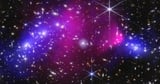
CBS News • Jan 26, 2026
Mysterious dark matter seen in new high-resolution map of distant galaxies