JWST Unveils MoM-z14: A Galaxy 13.5 Billion Years Old, Defying Cosmic Expectations
January 28, 2026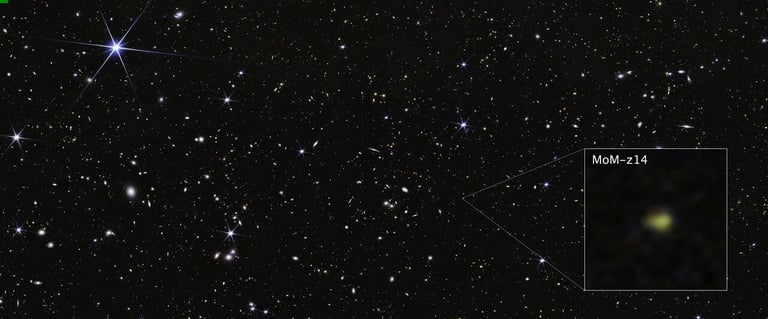


The study stresses that spectroscopy is crucial to accurately determine redshift and epoch, validating MoM-z14’s distant nature beyond photometric estimates.
In particular, JWST’s NIRSpec confirmed MoM-z14’s redshift and timing, solidifying its status as a very distant galaxy.
Researchers including Rohan Naidu, Pascal Oesch, Jacob Shen, and Yijia Li emphasize the excitement and lingering questions about how the earliest galaxies formed and contributed to reionization.
The Webb findings highlight the ongoing international collaboration among NASA, ESA, and CSA, with NIRSpec and related instruments playing central roles in these discoveries.
Webb’s mission continues to map the early universe, guiding future missions and theories as observations expand the sample of ancient galaxies.
Cosmological redshift is explained as a measure of light travel distance in an expanding universe, with reionization providing crucial context for these early epochs.
MoM-z14’s age and properties were determined through JWST’s Near-Infrared Spectrograph, which tracks how the galaxy’s light shifts in wavelength over vast distances.
Spectroscopic confirmation via NIRSpec is essential for precise distance and timing, reinforcing the need for follow-up observations beyond imaging alone.
NASA notes that the record could be surpassed as observations improve, reflecting the evolving and uncertain nature of measuring cosmic distances.
Astronomers using JWST have discovered MoM-z14, a galaxy about 13.5 billion years in the past at a redshift of 14.44, pushing the observable edge of the early universe and challenging prelaunch theoretical predictions by appearing roughly 100 times brighter than expected for such an early galaxy.
This discovery continues Webb’s legacy of pushing back cosmic boundaries, following earlier confirmations like GN-z11 and reinforcing a growing gap between models and observations in the infant universe.
MoM-z14 fits a pattern of unexpectedly luminous early galaxies, underscoring a mismatch between theory and observation in the universe’s first hundreds of millions of years.
Summary based on 6 sources
Get a daily email with more Tech stories
Sources
Scientific American • Jan 28, 2026
JWST spots most distant galaxy ever, pushing the limits of the observable universe
Yahoo! • Jan 28, 2026
Astronomers share new insights about the early universe via the Webb Space Telescope
Phys.org • Jan 28, 2026
Webb pushes boundaries of observable universe closer to Big Bang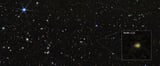
NASA Science • Jan 28, 2026
NASA Webb Pushes Boundaries of Observable Universe Closer to Big Bang - NASA Science