James Webb Telescope Unveils MoM-z14: Most Distant Galaxy Challenges Early Universe Theories
January 29, 2026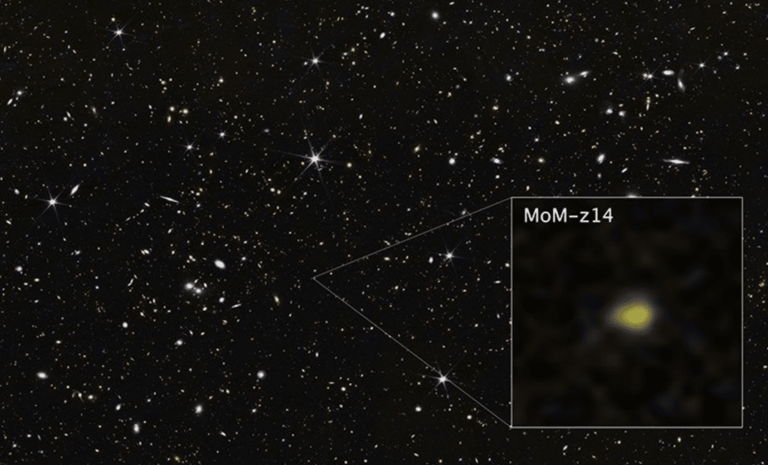

MoM-z14 is the most distant spectroscopically confirmed galaxy to date, at z = 14.44, about 280 million years after the Big Bang.
JWST has revealed more bright, ancient galaxies than expected, raising questions about early galaxy formation and the cosmic dawn.
MoM-z14’s brightness and chemical complexity, including nitrogen enrichment, suggest rapid chemical evolution and possible supermassive star presence in the early universe.
The James Webb Space Telescope has confirmed MoM-z14, a galaxy existing about 280 million years after the Big Bang, with a redshift of 14.44, making it one of the earliest and most distant galaxies observed.
The galaxy is unusually nitrogen-rich relative to carbon, resembling globular clusters in the Milky Way and implying early, rapid chemical evolution.
Spectroscopy proved crucial for precise distance measurements and timelines of reionization, clarifying how early light transformed the universe’s hydrogen fog.
The discovery challenges existing models of early galaxy formation and star formation timelines, widening the gap between observations and theory.
This finding extends the observable frontier, challenging theories of galaxy formation in the first 500 million years after the Big Bang.
Researchers note an exciting tension between observation and theory and anticipate new insights from a larger dataset of ancient galaxies.
The study Naidu et al. (2025) A Cosmic Miracle: A Remarkably Luminous Galaxy at z=14.44 Confirmed with JWST is cited, with Open Journal of Astrophysics publication noted in 2026.
MoM-z14 fits into a broader trend of JWST expanding the observable universe and redefining expectations for the early cosmos.
Follow-up observations led by Rohan Naidu (MIT) confirmed MoM-z14’s high redshift and nature.
Summary based on 2 sources
Get a daily email with more Science stories
Sources
The Daily Galaxy - Great Discoveries Channel • Jan 29, 2026
Webb Telescope Discovers Ancient Galaxy That Challenges Theories On Early Universe