Revolutionary Cryogenic Coolant Uses Abundant Elements, Eliminates Need for Rare-Earths in MRI and Quantum Cooling
February 4, 2026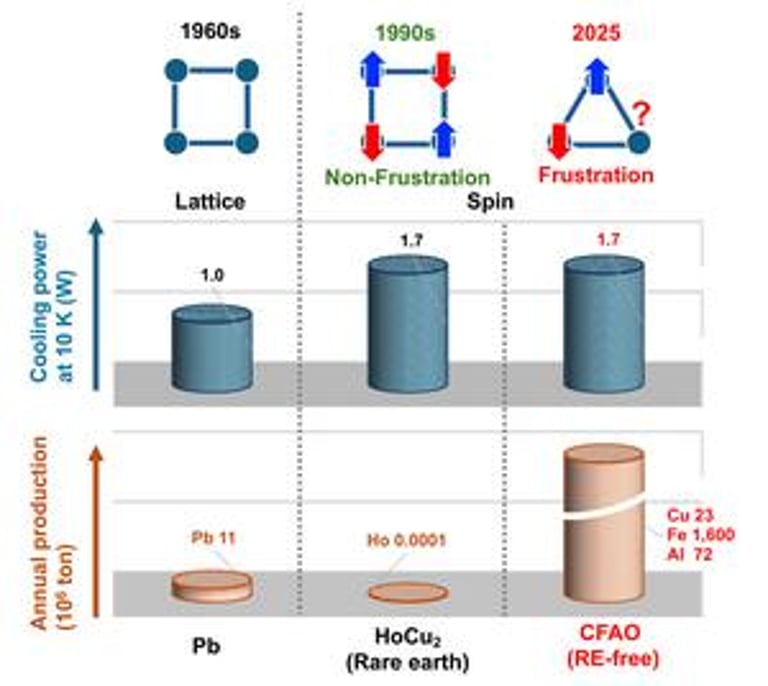

A new cryogenic cooling material uses magnetic frustration on a CuFeO2 triangular lattice to sustain high specific heat at very low temperatures, enabling efficient cooling around 4 K without rare-earths.
The work was published in Scientific Reports on December 22, 2025, with Noriki Terada, Hiroaki Mamiya, Akiko Saito of NIMS, and Shinji Masuyama of KOSEN, Oshima College leading the research under JST A-STEP.
The breakthrough addresses supply concerns for liquid helium and scarce rare-earth elements, which are critical for MRI cooling and quantum computing applications.
Current regenerator samples achieve about 55% chamber filling; with spherical granulation and optimized particle size, efficiency could reach around 65%, with potential to tailor dimensions for optimal gas flow and thermal conductivity.
The Scientific Reports article by Terada and colleagues presents the concept of an abundant-element-based cryogenic coolant, under the title Innovative cryogenic cooling material using spin frustration from abundant elements.
Compared with holmium-based systems, the new material shows antiferromagnetic behavior with weak field-induced magnetization, reducing magnetic noise and mechanical stress in MRI and improving reliability for high-field superconducting magnets.
A collaborative effort from NIMS, KOSEN, and Oshima College produced a regenerator material made entirely from abundant elements like copper, iron, and aluminum, achieving about 4 K without rare-earth metals or liquid helium.
A copper–iron–aluminum oxide compound demonstrated cryogenic cooling below 4 K, with the best sample reaching around 3.13 K and 0.117 watts of cooling power.
Potential applications include MRI cryogenic cooling and cooling for quantum computing, driven by independence from scarce resources and environmental advantages.
Using abundant elements instead of scarce rare-earths could reshape the supply chain and geopolitics of cryogenic cooling for MRI and future quantum computers.
Introducing a small amount of aluminum into CuFe oxide broadens the operational temperature range and enhances cooling capacity by altering the low-temperature magnetic structure.
The material delivers practical performance comparable to traditional rare-earth–based cooling materials and marks the first practical magnetic regenerator for GM coolers that does not use rare-earth elements.
Summary based on 3 sources
Get a daily email with more Science stories
Sources
Phys.org • Feb 4, 2026
Cryogenic cooling material composed solely of abundant elements reaches 4K
ScienceBlog.com • Feb 3, 2026
The ‘Frustration’ That Could Cool Quantum Computing’s Future