Climate Shifts and Human Activity Drive Rhinoceros Migration to Kaziranga, Study Reveals
February 4, 2026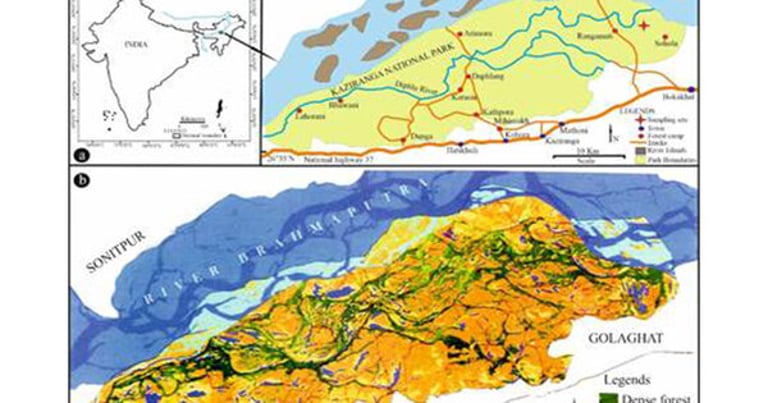

Pollen and fungal-spore evidence from mud layers reveals historical ecological conditions and hints of dung-associated traces, documenting ecological change over time.
A long-term study traces the decline and eastward relocation of megaherbivores across the Indian subcontinent due to late Holocene climate shifts, notably during the Little Ice Age, coupled with growing human activity, which helps explain why the rhinoceros is now confined to Kaziranga.
Northeastern India remained comparatively climatically stable and faced lower human pressure, facilitating eastward rhinoceros migration and concentration in Kaziranga rather than in harsher northwestern regions.
Publication link: https://doi.org/10.1016/j.catena.2025.109762.
Kaziranga National Park in Assam, a UNESCO World Heritage Site and stronghold of the Indian one-horned rhinoceros, is studied through palaeoecological records preserved in mud from the Sohola swamp, including pollen and fungal spores.
The Catena study, supported by India’s science ministry, analyzes biodiversity and ecosystem resilience in Northeast India and highlights the role of past environmental changes in shaping wildlife patterns.
Researchers from the Birbal Sahni Institute of Palaeosciences analyzed a sediment core from the Sohola swamp in Kaziranga, using pollen and fungal spores as proxies to reconstruct past vegetation and megaherbivore activity.
A nearly one-meter core yielded pollen grains and fungal spores that form a natural archive of vegetation history and megaherbivore presence.
The study emphasizes long-term vegetation and climate shifts as key drivers of wildlife survival, migration, and extinction, offering ecological insights to inform contemporary conservation under future climate-change scenarios.
The decline and confinement of megaherbivores to Kaziranga are linked to enduring environmental changes, illustrating how past shifts shaped survival and migration with implications for conservation and wildlife management amid ongoing climate change.
Understanding these deep-time ecological processes can inform present and future conservation strategies for Kaziranga and similar ecosystems.
Defs, including deforestation, urbanization, industrialization, floods, droughts, earthquakes, and landslides, contribute to biodiversity loss globally, with the Northeast region acting as a refugium that supported rhinoceros survival and concentration in Kaziranga.
Summary based on 6 sources
Get a daily email with more Science stories
Sources

Big News Network.com
Researchers trace Kaziranga's evolution into last great home of one-horned rhino
India Education Diary | Latest Education News | Global Educational News | Recent Educational News • Feb 4, 2026
Researchers trace evolution of Kaziranga to the last great Home of the one-horned rhino - India Education | Latest Education News | Global Educational News | Recent Educational News