Astronomers Uncover Rare 'Failed Supernova' in Andromeda, Star Quietly Becomes Black Hole
February 12, 2026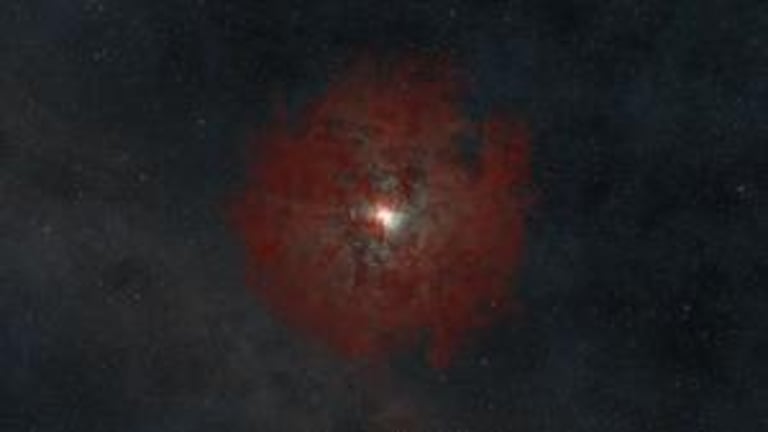

Astronomers have documented the quiet collapse of a massive star in Andromeda, labeled M31-2014-DS1, a rare “failed supernova” in which the star collapses into a black hole without a bright explosion.
turbulent convection in the outer layers caused slow accretion of material and dust formation, producing an infrared glow that lingered for years as the system faded.
The object brightened in infrared around 2014, then faded rapidly by 2016 and effectively vanished from visible and near-infrared light by 2022–2023, with only faint mid-infrared emission remaining.
The findings are published in Science, based on a decade of archival data plus new observations, with support from NASA and the Simons Foundation and data from Hubble, Spitzer, and ground-based telescopes.
Key uncertainties include whether dust obscuration could mimic the signal and the need for independent verification with future data.
Lead researchers used archival NEOWISE data (2009–2024) alongside Hubble, JWST, and Chandra to characterize the transition and estimate a black hole of about five solar masses hidden by dust.
Kishalay De and colleagues refined models and interpreted multi-telescope data spanning 2005–2023 from NEOWISE and other observatories.
The results help explain the diversity of massive-star death and establish a framework for identifying similar quiet-collapse events in the future.
The Science paper combines a decade of archival data with recent observations to confirm and refine theories of how massive stars die and form black holes.
The study, published February 12, 2026, reinforces models of black-hole formation from dying stars via dust-enshrouded, non-explosive pathways.
Experts highlight the need for follow-up with facilities like Rubin Observatory and Roman Space Telescope to determine how common failed collapses are and to distinguish them from dust-shrouded mergers.
While the result is exciting, some researchers caution about alternative explanations and call for continued observations to confirm the black-hole formation.
Summary based on 9 sources
Get a daily email with more Science stories
Sources
NPR • Feb 12, 2026
Have astronomers witnessed the birth of a black hole?
Yahoo News • Feb 12, 2026
Astronomers observe a star that quietly transformed into a black hole
Scientific American • Feb 12, 2026
Did astronomers just see a star blink out to become a black hole?
Phys.org • Feb 12, 2026
Failed supernova provides clearest view yet of a star collapsing into a black hole