Ancient Skeletons Unearthed in Tulum Cenotes Reveal Ritual Burials and Migration Mysteries
March 1, 2026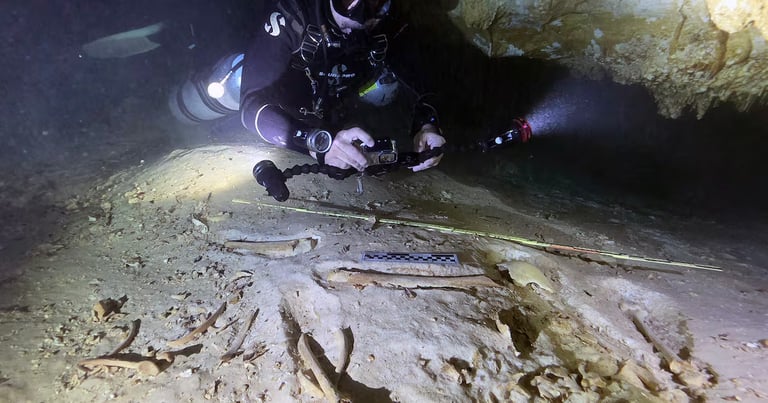


The 11th skeleton found in cenotes between Tulum and Playa del Carmen over three decades appears to be intentionally buried or deposited in a dune of sediments inside an interior chamber, suggesting ritual or ceremonial practices.
Divers continue exploring the flooded cave system, with ongoing discoveries and challenges preventing full fossil recovery due to access and preservation constraints.
Ecologists and archaeologists stress the caves’ fragile ecosystems and cultural heritage, reinforcing efforts to safeguard underwater waterways from pollution and degradation as exploration proceeds.
Dating suggests some remains go back to about 13,000 years ago, underscoring the cenotes’ significance as a long-term archaeological site.
Archaeologist Octavio del Río notes the burial-like placement within a sediment dune inside a chamber, reinforcing the interpretation of deliberate deposition.
The discovery occurs in a landscape shaped by development pressures, notably the Maya Train project, and officials plan to designate the broader area as a national protected area in 2026.
DNA evidence increasingly supports early human migration from Asia, while hints of alternative routes enrich understanding of Yucatán prehistory.
Construction and development, including the Maya Train, have raised concerns about the impact on these fragile underwater systems, prompting calls for protection and environmental safeguards.
Researchers say the discovery helps illuminate how people reached the Yucatán Peninsula and how they used the cave networks, contributing to ongoing debates about migration routes from Asia via a Bering land bridge or alternate paths from South America.
Findings point to multiple hypotheses about how ancient populations arrived in the Yucatán, including potential land-bridge crossings from Asia and other possible routes from South America.
The site has yielded other significant finds over time, reinforcing its value as both an ecological treasure and an archaeological window into the region’s past.
Beyond ancient remains, the caves have yielded items like a small cannon and 19th-century rifles, illustrating the caves’ long, layered history as cultural archives.
Summary based on 3 sources
Get a daily email with more World News stories
Sources
Yahoo News • Feb 28, 2026
A prehistoric skeleton found deep in a flooded Mexican cave was likely placed there in a ritual
AP News • Feb 28, 2026
Ancient skeleton found in underwater Mexican cave | AP News