Revolutionary Half-Möbius Molecule Engineered with Switchable Topology, Paving Way for Future Chemistry Innovations
March 5, 2026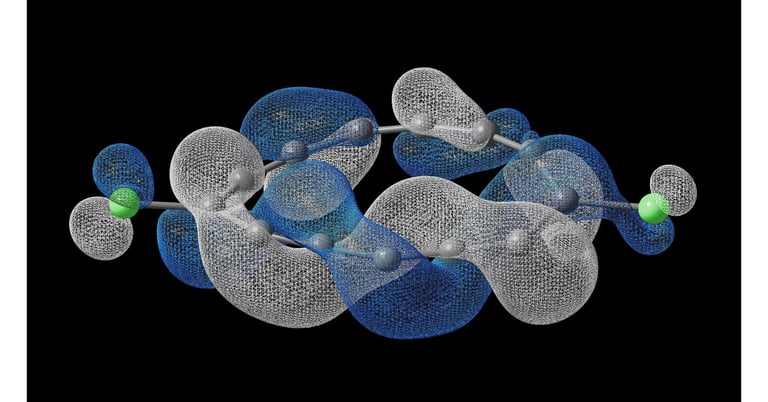


A team of researchers from Manchester, Oxford, Regensburg, Lausanne and IBM Research Europe used atom-manipulation tools to create a novel 13-carbon ring molecule, C13Cl2, with a half-Möbius electron-orbital topology by selectively removing chlorine atoms from a fully chlorinated C13Cl10 ring.
The molecule was assembled on a gold surface at cryogenic temperatures, precisely manipulated with atomic force microscopy and scanning tunnelling microscopy to shape its topology and map electron distributions.
Imaging and experiments revealed a corkscrew-like electronic structure that twists 90 degrees per circuit, requiring four loops to return to the starting phase, a topology not observed in chemistry before.
The topology can be reversibly switched among clockwise-twisted, counterclockwise-twisted, and untwisted states, demonstrating controllable electronic topology in a single molecule.
Atomic force microscopy and scanning tunnelling microscopy confirmed the half-Möbius geometry and showed a twisted lowest-unoccupied molecular orbital in the half-Möbius singlet state versus a planar untwisted orbital in the triplet state.
Bias-voltage control via the microscope tip enables the molecule to shift among left-handed half-Möbius, right-handed half-Möbius, and planar configurations, illustrating switchable topology on demand.
A small electromagnetic pulse demonstrated controllable topology, enabling reversible switching between twisted and untwisted states.
Quantum computing played a central role in validating the electronic configuration and topology, with simulations run on both conventional computers and IBM's quantum processor to understand the system.
The work showcases two advances: engineered electronic topology in chemistry and practical quantum simulations that tackle molecular-scale systems beyond classical capabilities.
Hybrid quantum-classical workflows and 72-qubit quantum calculations contributed to capturing deeply entangled electron interactions and the helical pseudo-Jahn–Teller effect that drives the topology.
The half-Möbius topology imposes unique boundary conditions and Berry phase characteristics, which could influence magnetic, electronic, and spin-dependent properties.
The study points to future prospects for more complex, topology-switchable molecules and networks, expanding topology-driven chemistry.
Summary based on 7 sources
Get a daily email with more Tech stories
Sources
Cision PR Newswire • Mar 5, 2026
IBM and University Researchers Create a Never-Before-Seen Molecule and Prove its Exotic Nature with Quantum Computing
Scientific American • Mar 5, 2026
IBM scientists unveil the first ever “half-Möbius” molecule, with the help of quantum computing
New Scientist • Mar 5, 2026
Möbius strip-like molecule has an entirely new and bizarre shape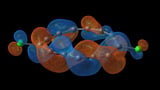
Science News • Mar 5, 2026
This molecule puts a new twist on the Möbius strip