Cambridge Team Pioneers Metal-Free, Light-Activated Drug Modification for Greener Pharmaceutical Manufacturing
March 13, 2026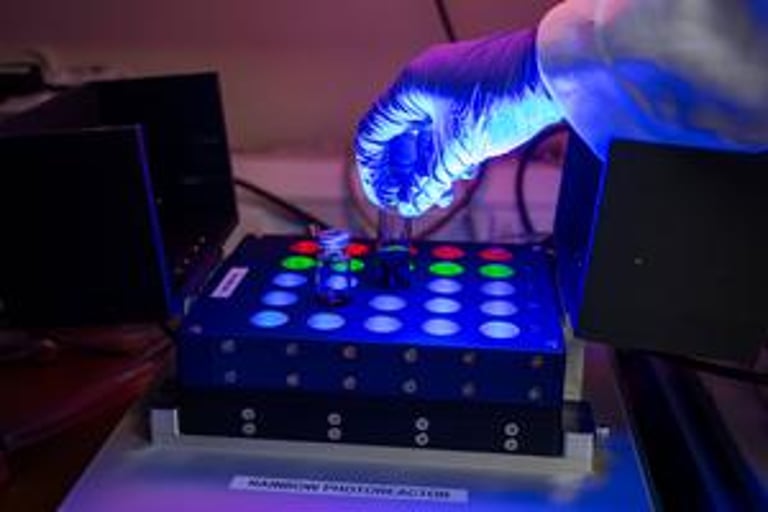

The Cambridge group emphasizes sustainability and greener chemical production, aligning with broader energy-transition goals in the pharmaceutical industry.
The Nature Synthesis paper, published March 12, 2026, led by David Vahey and Erwin Reisner, highlights practical, scalable chemistry and provides the DOI 10.1038/s44160-026-00994-w.
AstraZeneca collaborated to assess industrial practicality and demonstrated the method across diverse drug-like molecules, including potential adaptation to continuous-flow systems.
The collaboration evaluated real-world applicability and scalability, testing the rule across large-scale development scenarios.
Contributors include David M. Vahey of St John’s College, Cambridge, Erwin Reisner, with Trinity College Dublin contributing AI models to predict reaction sites.
AI-assisted analysis and machine-learning models helped predict where the reaction would occur on new molecules, speeding candidate identification and reducing trial-and-error in discovery.
The approach offers high functional-group tolerance and adapts to continuous-flow systems, with potential to cut waste, energy use, and development time in pharmaceutical manufacturing.
The work underscores sustainable chemistry options, aligning with broader goals to reduce environmental impact in drug synthesis.
A Cambridge University team has developed a light-activated, metal-free anti-Friedel–Crafts alkylation that enables late-stage modification of complex drug molecules under ambient LED light.
This visible-light–driven approach operates at room temperature to tailor drug molecules late in development, avoiding toxic heavy-metal catalysts.
The method forms carbon–carbon bonds through a self-sustaining, photoinitiated chain process, enabling precise late-stage tweaks rather than rebuilding molecules from scratch.
Summary based on 3 sources
Get a daily email with more Science stories
Sources
EurekAlert! • Mar 12, 2026
Failed experiment by Cambridge scientists leads to surprise drug development breakthrough
News-Medical • Mar 13, 2026
Cambridge’s LED breakthrough reinvents drug synthesis
SciTechDaily • Mar 12, 2026
A Cambridge Lab Mistake Reveals a Powerful New Way to Modify Drug Molecules