Gerd Faltings' Pioneering Work in Number Theory Earns Prestigious Abel Prize
March 19, 2026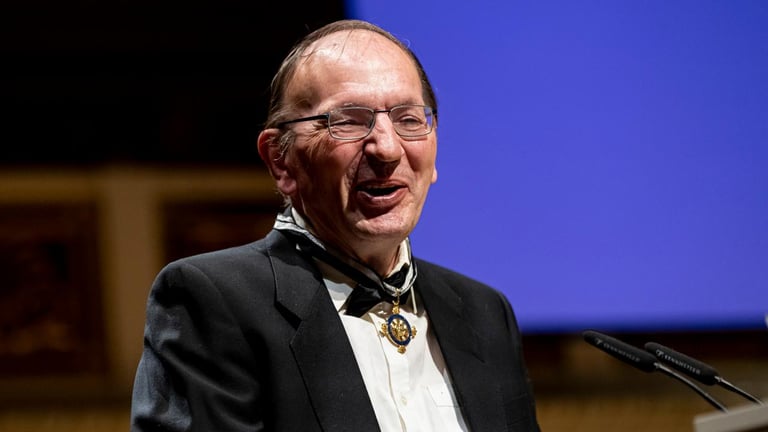

Faltings, now retired since 2023, resides in Bonn with his two daughters and is a lifelong Schalke 04 fan.
Faltings remains modest about current challenges, noting the abundance of active researchers and preferring not to compete.
The article closes with an appeal for continued support of science journalism from Scientific American.
Faltings’ career includes the Fields Medal in 1986 and the Leibniz Prize in 1996, with studies and work at Princeton and the Max Planck Institute for Mathematics in Bonn.
He is affiliated with the Max Planck Institute in Germany and is recognized for the Fields Medal-winning work that launched his renowned contributions.
Faltings achieved prominence early, becoming a professor at 27 and soon proving what is now known as Faltings’ theorem.
His 18-page proof interweaves geometry and arithmetic, surprising mathematicians with its breadth and cohesion.
Gerd Faltings’ landmark work shows that, beyond special cases, equations with higher powers generally have only finitely many rational solutions, reshaping the landscape of number theory and Diophantine equations.
This result builds on Fermat’s Last Theorem insights and marks a pivotal advancement in algebraic equations, clarifying when Diophantine problems admit finitely many solutions.
The Abel Prize, one of mathematics’ top honors, carries about 670,000 euros and this year marks its 24th anniversary.
Awarded by the Norwegian Academy of Sciences, the Abel Prize is widely regarded as a Nobel-like accolade for math.
Helge Holden, chair of the Abel Committee, calls the announcement a major milestone and highlights Faltings’ lasting impact on arithmetic geometry.
Summary based on 4 sources
Get a daily email with more Science stories
Sources
Nature • Mar 19, 2026
Mathematician who reshaped number theory wins prestigious Abel prize
Scientific American • Mar 19, 2026
Gerd Faltings, mathematician who proved the Mordell conjecture, wins the Abel Prize at age 71
New Scientist • Mar 18, 2026
Mathematician wins 2026 Abel prize for solving 60-year-old mystery