China Unveils Centaur Robot: Revolutionizing Human-Machine Synergy for Heavy Load Transport
March 24, 2026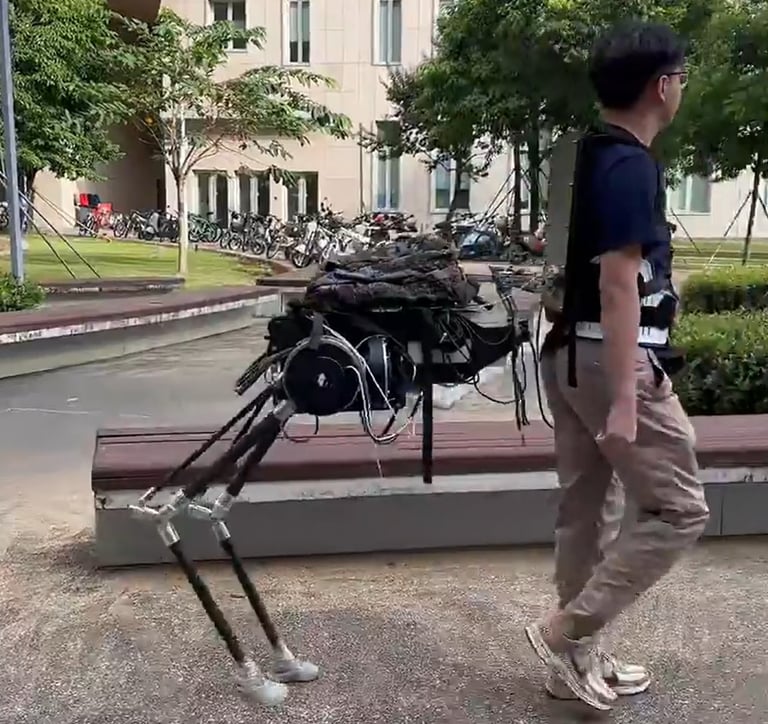


A research team at the Southern University of Science and Technology in Shenzhen unveiled the Centaur robot, a wearable system that adds two robotic legs and a robotic torso to transform a person into a four‑legged human–robot hybrid designed to reduce effort and improve movement when carrying heavy loads.
The Centaur features two independent 3‑DoF robotic legs plus a robotic torso, interfacing with the wearer via a passive elastic back connector to share load while preserving balance and navigation.
In effect, the Centaur is a distinct robotic pair of legs and torso that fuses with the human to enable a seamless human–robot collaboration.
Researchers foresee applications in military logistics, disaster relief, and industrial transport where workers must move heavy equipment across difficult terrain.
Examples of potential use include moving heavy gear during military operations, disaster response tasks, and industrial tasks that require carrying loads over challenging surfaces.
Industry context notes China’s growing humanoid‑robot ecosystem, with hundreds of manufacturers and dozens of announced models, and a market for humanoid robots and embodied AI projected to reach roughly 100 billion yuan by 2030.
The Centaur project sits within China’s broader push on non‑invasive cyborg and exoskeleton tech, backed by national support for humanoid robots and related military and industrial applications.
Video demonstrations show the Centaur moving smoothly on stairs, slopes, and rough terrain, indicating stable mobility across varied environments.
Testing indicates the Centaur can adapt to different walking directions and speeds, while substantially reducing metabolic energy use and foot loading when carrying about 20 kilograms.
With around a 20 kg load, energy expenditure dropped by roughly 35% and foot pressure by about 52% compared with unaided walking.
Advanced motion‑planning and control systems were developed so the robotic legs synchronize with the user’s speed and direction, enabling natural walking patterns during trials.
The findings are published in The International Journal of Robotics Research, highlighting the Centaur as a notable advancement in wearable robotics and human augmentation.
Summary based on 3 sources
Get a daily email with more Tech stories
Sources

Metro • Mar 22, 2026
Scientists create human-robot hybrid that turns people into bionic centaurs
indonesiakini - Cerdas Mengabarkan • Mar 24, 2026
Aussie Scientists Forge Bionic Centaur Hybrid - indonesiakini