Japanese Study Reveals Cloning Limit: 58 Generations of Mice Show Genetic Decay Risks
March 24, 2026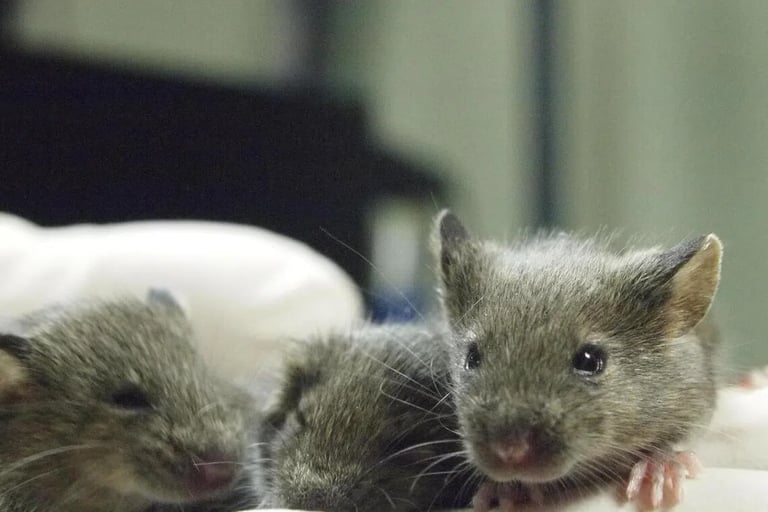


The results align with Muller’s ratchet: deleterious mutations accumulate in asexual lineages, risking mutational meltdown and possible extinction.
The study was published in Nature Communications and led by geneticist Sayaka Wakayama.
Even when clones appeared normal with ordinary lifespans, genetic changes accumulated each cycle, increasing the likelihood of future cloning failures and limiting long-term viability.
The researchers demonstrated the replication process through nuclear transfer, reinforcing the technique’s limits observed in this long-running study.
While researchers aim to improve cloning methods, there is no clear solution to prevent meltdown, and teams are pursuing non-lethal cell collection techniques to aid endangered species recovery.
Clones were produced using nuclear transfer, the same method as Dolly and Cumulina, with cumulus cells serving as the source.
A long-running Japanese study cloned more than 1,200 mice across 58 generations using nuclear transfer, and found a finite limit to mammalian cloning as the 58th generation died shortly after birth.
Authors say the accumulating mutations could generalize to vertebrate cloning and have major implications for agriculture and animal breeding that rely on cloning to preserve genomes.
Findings suggest a practical limit to cloning across generations and imply that sexual reproduction may reset mutation load, offering insight into why sex persists in mammals.
Initial generations showed improving cloning success, but by generation 25 chromosomal abnormalities appeared and the X chromosome was lost, with mutation frequencies nearly doubling by generation 57.
Across 20 years and 58 generations with over 30,000 cloning attempts, researchers tested whether a single lineage could be indefinitely cloned via asexual reproduction.
The overarching takeaway: repeated mammalian cloning drives irreversible genetic decay, underscoring the essential role of sexual reproduction in maintaining genome integrity.
Summary based on 6 sources
Get a daily email with more Tech stories
Sources
Nature • Mar 24, 2026
Can a mouse be cloned indefinitely? Decades-long experiment has answers
Yahoo News • Mar 24, 2026
Mouse study shows repeated cloning causes grave genetic mutations
Gizmodo • Mar 24, 2026
How Many Times Can You Clone a Clone? New Research Offers a Surprising Answer
ST • Mar 24, 2026
Mammals cannot be cloned infinitely, mice study discovers