Breakthrough MoSe2 Gratings Revolutionize Photonic Circuits with Unprecedented Light Control
April 5, 2026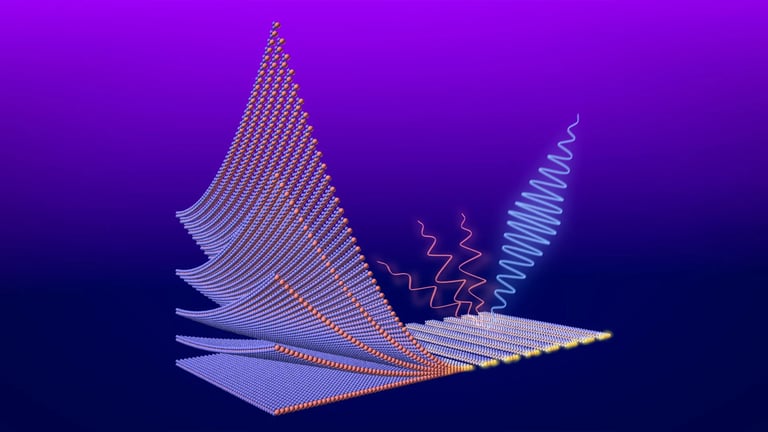

Ultrathin MoSe2-based gratings could advance photonic integrated circuits by enabling effective light control in much thinner, scalable structures.
The research, published in ACS Nano, is funded by European and Polish sources including the National Science Centre, ERC-ADVANCED grant No. 101053716, the Foundation for Polish Science, and the University of Warsaw.
MoSe2 layers were grown via molecular beam epitaxy, producing large, uniform films spanning several square inches and addressing exfoliation limitations that yielded tiny areas.
The structure enables third harmonic generation, converting infrared photons into visible blue light, with the grating enhancing efficiency by more than 1,500 times compared with a flat MoSe2 layer.
MoSe2 has a high refractive index that slows light more than glass or silicon, enabling dramatic size reduction while maintaining confinement, with a thickness over a thousand times thinner than a human hair.
A subwavelength grating using MoSe2 traps infrared light in a layer only 40 nanometers thick, more than 1,000 times thinner than a human hair.
The structure confines and concentrates infrared light, acting like a near-perfect mirror and enabling light manipulation at scales below the wavelength.
This advancement could streamline photonic technologies by enabling smaller, faster devices and scalable production for real-world use.
Summary based on 2 sources
Get a daily email with more Science stories
Sources

ScienceDaily • Apr 5, 2026
Scientists trap light in a layer 1,000x thinner than hair
footer-brand-icon • Apr 5, 2026
Scientists trap light in layer 1,000x thinner than hair: Study