Cygnus X-1 Black Hole Jets Measured at Half Light Speed, Equivalent to 10,000 Suns' Power
April 16, 2026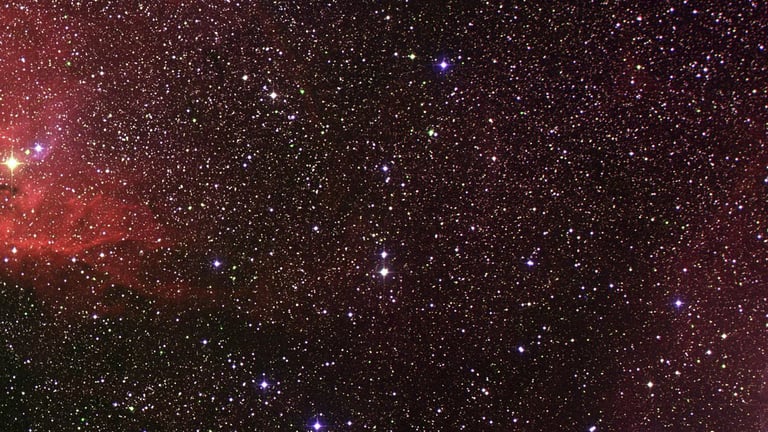


A new study published in Nature Astronomy reports that jets emanating from the Cygnus X‑1 black hole travel at about half the speed of light and carry roughly 10 percent of the total energy released by matter accreting onto the black hole, equivalent to the power output of about 10,000 suns.
For the first time, researchers measured the instantaneous power and speed of these jets, finding jet power around 10,000 solar luminosities and speeds near 355 million mph (540 million kph).
The team links jet activity to the black hole’s feeding rate and growth, offering insights into how jets influence their environment and potentially shape galaxy evolution.
Using nearly two decades of data from the VLBA and EVN, scientists reconstructed high-resolution, time-resolved images that captured a dancing motion of the jets caused by interactions with the companion star’s stellar wind.
Jet measurements were achieved by tracking their wobble through combined radio telescope images, yielding a more precise picture of jet structure than previous attempts.
Cygnus X‑1’s long history dates back to its discovery in the 1960s, with ongoing gas accretion from its companion that fuels jet activity.
The analysis draws on 18 years of high-resolution radio imaging from a global telescope network and uses jet bending from the stellar wind, plus computer modeling, to estimate jet power.
Energy estimates arise from multi-telescope radio imagery showing the jet–stellar wind interaction causes the jets to bend and appear to “dance,” enabling power calculations.
Jets are conceived as being pushed in opposite directions by the stellar wind, a dynamic that provides the basis for determining their power through bending and modeling.
Researchers including Steve Prabu and James Miller-Jones presented the findings, framing them as a major step in understanding one of the universe’s most energetic phenomena.
The jets originate from the accretion disk around the black hole and are shaped by a strong magnetic field and radiation from the companion star, causing the jets to bend and dance.
The study touches on the broader astrophysical question of how jet shocks and outflows can either trigger or suppress star formation, influencing cosmic structure growth over time.
Summary based on 6 sources
Get a daily email with more World News stories
Sources
AP News • Apr 16, 2026
Scientists measure power of jets blasting from black hole | AP News
New York Post • Apr 16, 2026
First black hole ever discovered emitting 'dancing jets' as powerful as 10,000 suns
Yahoo News • Apr 16, 2026
Astronomers measure the mind-blowing power and speed of black hole jets for the first time
ABC News • Apr 16, 2026
Astronomers measure the mind-blowing power and speed of black hole jets for the first time