New Study Reinforces Dark Matter Role, Challenges Modified Gravity Theories
April 17, 2026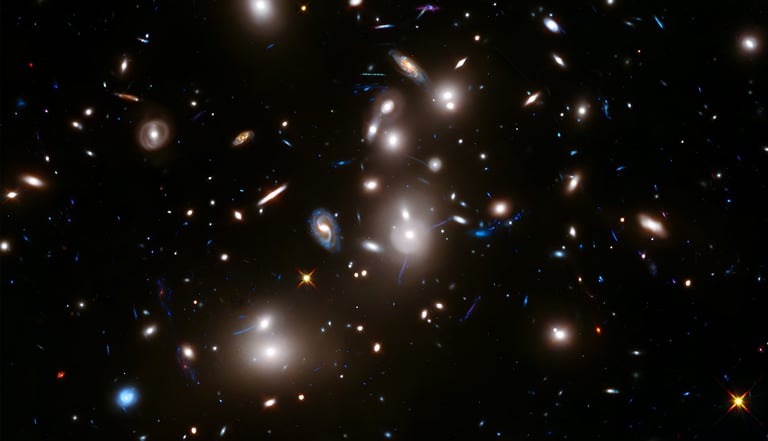

The study constrains alternative gravity theories such as MOND, making them less viable as explanations for galaxy motions without dark matter.
The analysis shows near-perfect agreement with Newtonian and Einsteinian predictions, arguing against gravity-based explanations for cosmological discrepancies.
The results indicate gravity weakens with distance in line with Newton’s law, consistent with the standard cosmological model over vast scales.
The findings challenge certain modified gravity theories proposed to explain cosmological observations without dark matter and reinforce the need for dark matter to account for galactic and cluster dynamics.
Though dark matter is not directly detected in this study, the results reinforce its role in explaining galactic and cluster dynamics.
Data from the Atacama Cosmology Telescope and the Sloan Digital Sky Survey observe light from about 380,000 years after the Big Bang, tracking gravitational distortions as light passes massive clusters.
A new study uses data from the Atacama Cosmology Telescope and a comprehensive galaxy catalog to infer cluster motions and test gravity, addressing whether physical laws hold universally across cosmic distances.
By analyzing the motions of galaxy clusters separated by hundreds of millions of light-years with the kinematic Sunyaev–Zeldovich effect and a large galaxy map, the researchers test gravity on the largest scales.
The authors stress the result is model-independent, suggesting that any residual discrepancies are more likely due to unseen matter than a breakdown of gravity itself.
Key figures, including Kris Pardo, affirm that the results align with gravity as currently understood, while Patricio Gallardo and colleagues underscore dark matter’s strengthened case and the promise of future precision improvements.
The study finds that general relativity and Newtonian gravity accurately describe gravity on the largest cosmic scales, reinforcing traditional gravity theories over modified-gravity alternatives.
Described as one of the largest-scale direct tests of gravity to date, the researchers anticipate future surveys with more data will tighten constraints and possibly reveal small deviations.
Summary based on 2 sources
Get a daily email with more Science stories
Sources
Gizmodo • Apr 17, 2026
Not Even the Largest Cosmic Objects Can Escape Newton and Einstein, Study Finds
USC Dornsife News • Apr 16, 2026
Scientists test a fundamental rule of gravity on cosmic scales — and it holds up