Interstellar Comet 3I/ATLAS Reveals Unique Composition and Early Activity in Pre-Discovery Images
May 16, 2026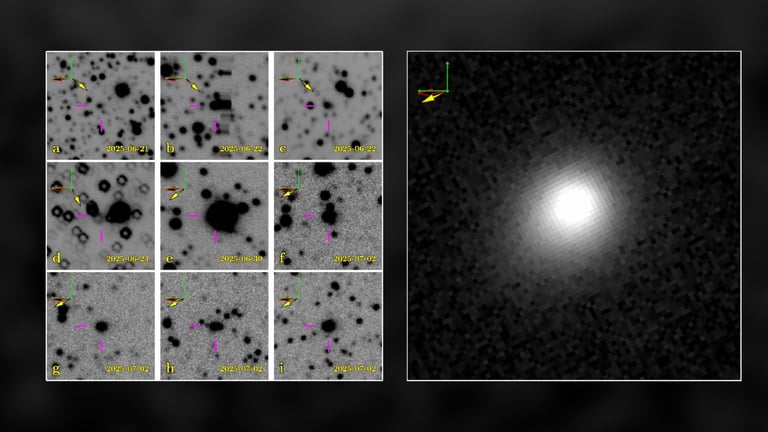

Observations show a visible coma around the comet, signaling activity as it neared the Sun and reinforcing its interstellar origin.
Interstellar comet 3I/ATLAS was identified in July 2025, but Rubin Observatory imagery from late June to mid-July 2025 shows the object was active before its official discovery and could have been spotted earlier if Rubin’s validation pipeline had been online.
Spectroscopic data and JWST findings indicate the nucleus is about one kilometer across and that the comet travels at roughly 61 km/s, with an estimated age between seven and twelve billion years, suggesting it has endured multiple stellar encounters.
A study published in The Astrophysical Journal Letters on April 20 details Rubin Observatory’s observations and contributes to the broader understanding of interstellar objects and their origins.
Joint observations by the JUICE and Europa Clipper missions in late 2025 detected hydrogen, oxygen, and carbon emissions from 3I/ATLAS, aiding composition analysis and indicating a higher carbon content than typical solar-system comets.
Inferred carbon dioxide levels point to a distinctive composition compared with solar-system comets, helping scientists compare 3I/ATLAS’s formation environment to that of our own system.
Rubin Observatory captured multiple pre-discovery images of 3I/ATLAS, and researchers built a custom data pipeline during validation to access and analyze those images.
Summary based on 1 source