GPCR Activation Unveils Orientation-Dependent β-Arrestin Oligomerization Patterns, Influencing Endocytosis and Signaling
May 27, 2026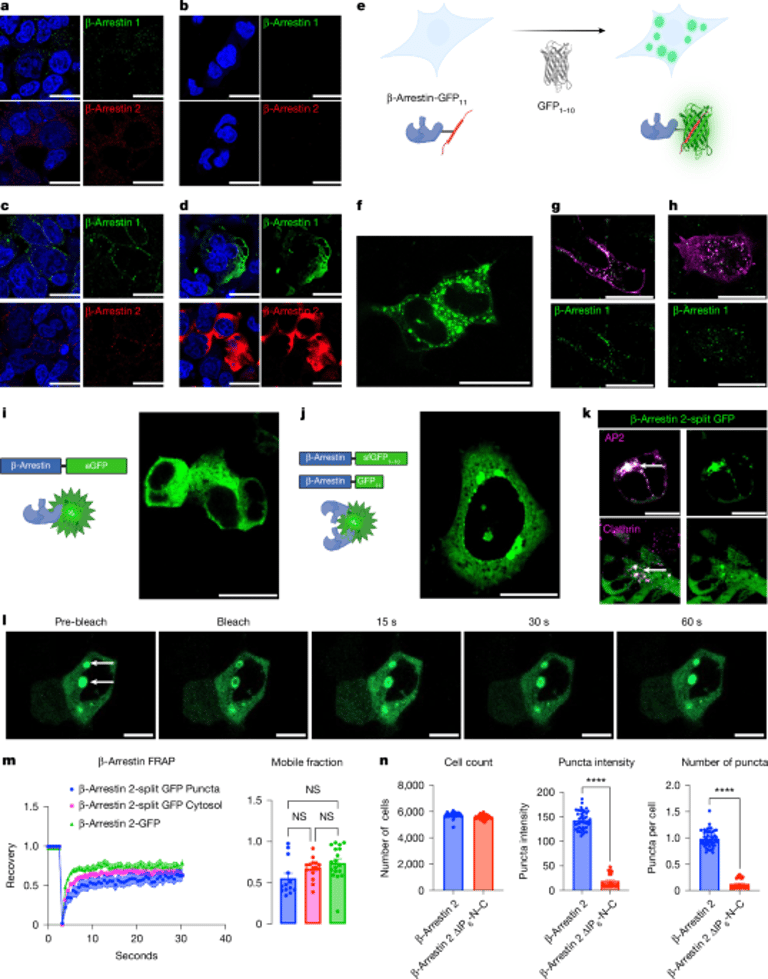

Condensates are dynamic and influenced by IP6-mediated oligomerization; disrupting IP6 binding reduces condensate formation, indicating IP6-dependent oligomerization drives LLPS of β-arrestins.
Optogenetic experiments show β-arrestins can form condensates rapidly upon blue light, with β-arrestin 1 readily forming condensates in response to light, while β-arrestin 2 shows more limited condensation, suggesting isoform-specific LLPS propensity.
GPCR endocytosis is linked to β-arrestin condensates: disruption with 16HD markedly reduces receptor internalization for class B receptors (V2R, AT1R), indicating condensates contribute to efficient endocytosis.
Endogenous β-arrestins form biomolecular condensates in cells at baseline and after GPCR stimulation, as shown by super-resolution imaging, split-GFP tagging, and FRAP analyses.
β-Arrestins regulate GPCR signaling by desensitization, scaffolding endocytic and signaling complexes, and trafficking, with activation triggered by receptor phosphorylation and conformational changes.
NanoBiT and BRET assays reveal GPCRs promote specific oligomerization orientations (N–N, N–C, C–C), and these patterns vary by receptor type and subcellular location (membrane, endosomes, CCPs).
LLPS of β-arrestins is more pronounced in the visual arrestin and β-arrestin families and does not broadly extend to the entire arrestin superfamily, as α-arrestins TXNIP and ARRDC1 do not form condensates under the same conditions.
GPCR activation modulates β-arrestin oligomerization in an orientation-dependent manner, with V2R and β2AR showing distinct oligomerization patterns at the receptor, endosomes, and clathrin-coated pits, indicating receptor-specific control over β-arrestin assembly near the receptor.
β-Arrestin oligomerization exhibits orientation dependence, with different interfaces (N–N, N–C, C–C) predominating under basal conditions, and receptor type influencing the favored orientation patterns.
Summary based on 1 source
Get a daily email with more Science stories
Source

Nature • May 27, 2026
β-Arrestin condensates regulate G-protein-coupled receptor function