University of Tokyo Study Reveals Cells' Unique Heat Retention Defies Classical Physics
May 28, 2026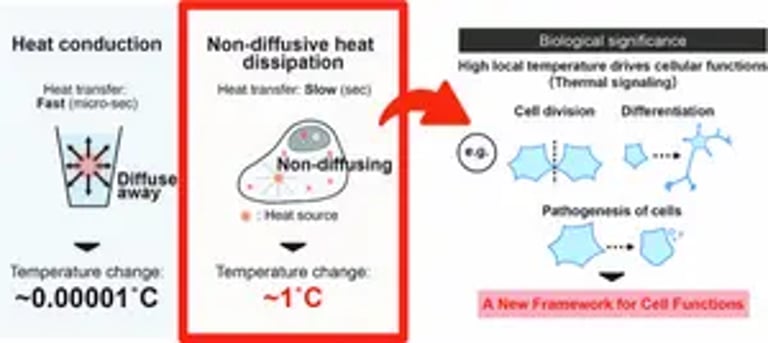

Interpretation: Intracellular heat may function as an energetic reservoir and signaling mechanism that modulates biochemical networks and cell fate decisions.
Context: Cellular temperature fluctuations (about 1–2 degrees) could influence processes such as neural stem cell differentiation and the heat shock response.
Keywords: Intracellular heat retention, thermal signaling, heat dissipation, fluorescence lifetime imaging, artificial liposomes, neural stem cells, heat shock response.
Methodology: Used high-speed fluorescence lifetime imaging and intracellular thermometry, heating a cell region with an infrared laser and tracking millisecond-scale cooling, comparing to similar-sized artificial liposomes.
Publication details: Report published in Nature Communications on May 28, 2026, with DOI 10.1038/s41467-026-71878-y.
Future directions: Uncover molecular mechanisms behind slow heat transfer and explore therapeutic approaches that leverage intracellular thermal environments.
Intro: A University of Tokyo study reveals living cells dissipate heat far more slowly than conventional physics would predict, unlike artificial liposomes, suggesting cells actively modulate their thermal dynamics.
Key finding: Living cells show nonspreading, localized heat retention that defies classical diffusion, indicating proteins, organelles, and cytoskeletal elements impede heat flow.
Interpretation: Slow, non-diffusive intracellular heat is intrinsic to living cells and may serve as an active energy source to drive cellular functions rather than being an experimental artifact.
Implications: This work opens cellular thermodynamics as an active research field with potential relevance to thermal signaling, energetic regulation, and diseases tied to temperature dysregulation.
Outlook: Researchers aim to decipher trapped-heat mechanisms, considering heat as a signaling tool to regulate cellular networks and potentially informing medical approaches for epilepsy, inflammation, and cancer.
Context: Builds on 2012 temperature mapping in live cells and challenges textbook views of thermodynamics in biology.
Summary based on 2 sources
Get a daily email with more Science stories
Sources
EurekAlert! • May 28, 2026
Heat lingers on in our cells
BIOENGINEER.ORG • May 28, 2026
Warmth Persists Within Our Cells, Study Finds