Mercury's Ice Mystery: Single Impact Event May Explain Polar Ice Deposits, Upcoming Mission to Confirm
May 29, 2026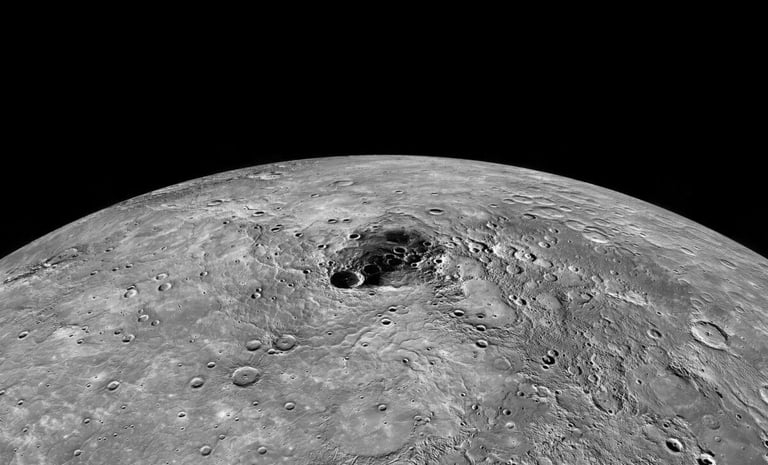

A single, roughly 17-kilometer-wide impactor struck Mercury at speeds up to 30 kilometers per second, generating a dense, temporary water-rich atmosphere that shielded ice from solar ultraviolet radiation and altered how water was delivered to the planet.
Atmospheric self-shielding in the dense vapor scenario dramatically increased ice preservation, raising non-escaping vapor trapping from 3.4% in a thinner atmosphere to 22.4% in the denser model.
Upcoming observations from the European-Japanese BepiColombo mission are expected to shed light on Mercury’s polar ice origin, as the spacecraft approaches Mercury after recent delays during trajectory adjustments.
BepiColombo, launched in 2018, is anticipated to provide further data on Mercury’s ice deposits once it orbits the planet starting in late 2026, refining our understanding of ice thickness and distribution.
The study detailing these computer simulations was published May 12 in the Journal of Geophysical Research: Planets, outlining a single-impact delivery model for Mercury’s water ice.
The transient, protective atmosphere allowed water molecules to survive long enough to migrate into permanently shadowed craters, explaining the concentration and purity of Mercury’s polar ice.
Water molecules that endured photolysis migrated to Mercury’s poles and were trapped in permanently shadowed regions, contributing to the observed polar ice deposits.
The scenario suggests about 2.3 × 10^13 kilograms of water ice could have been delivered to Mercury’s polar regions by a Hokusai-scale impact, with a distribution that's relatively balanced between the northern and southern poles due to vapor persistence.
The hypothesis emphasizes rapid, near-immediate deposition of ice following a single colossal collision, aligning with observations of ice in permanently shadowed craters and supporting a single-event delivery model.
Overall, the model aims to explain how Mercury retains substantial polar ice despite extreme daytime temperatures, by showing a dense post-impact atmosphere that shields water from photodissociation and concentrates it in cold traps.
The event would unfold over about one Mercurian day, roughly 157 Earth days, with the dense atmosphere lasting about an hour before water underwent photolysis and began migrating toward Mercury’s permanently shadowed polar regions.
Simulations estimate deposits could reach up to about 37 centimeters thick, indicating the original impactor might have been larger or slower to yield more preserved ice than some radar-based estimates suggesting several meters.
Summary based on 3 sources
Get a daily email with more Science stories
Sources
Gizmodo • May 29, 2026
A Single Asteroid Strike May Have Delivered All of Mercury’s Water, Study Finds
indonesiakini - Cerdas Mengabarkan • May 29, 2026
Mercury’s Polar Ice: A Single Giant Impact That Transformed the Planet in Hours - indonesiakini