Notre Dame Dig Unveils 2,000 Years of Parisian History: Roman Artifacts to Medieval Treasures
June 2, 2026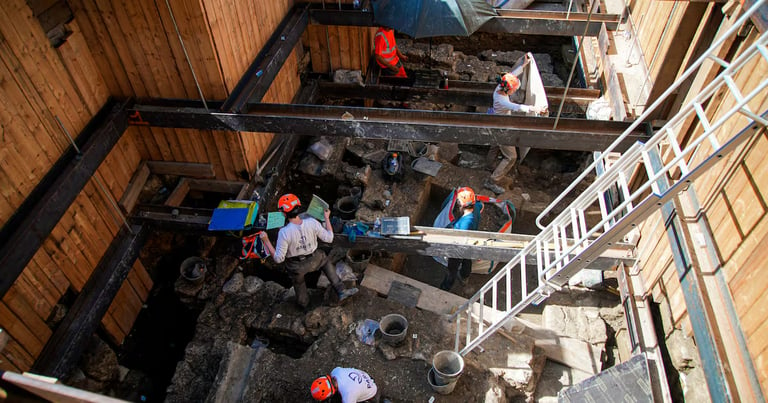


Key finds include a 4th-century Constantine coin, intact medieval pottery with internal markings, and Roman-era artifacts like a doorstep repurposed as paving, illustrating Paris’s layered history.
A major archaeological dig beneath Notre Dame’s forecourt has reached four meters below the surface, uncovering 2,000 years of Parisian history from Roman Lutetia through Merovingian and Carolingian eras.
Archaeologists are systematically excavating four meters underground from the forecourt to study Roman Paris and earlier layers, expanding understanding of the site beyond the visible cathedral.
The temporary dig, part of ongoing urban renovation, aims to reveal centuries of history by uncovering deeper strata beneath the forecourt.
Finds so far include late Roman to medieval waste deposits—jugs, cups, ceramics, bones, and nearly complete vessels—many preserved by ancient drainage practices.
Coins and other artifacts are used to date the layers, with Constantine coins serving as chronological anchors for deeper strata.
Redevelopment plans call for about 160 trees, a cooling water feature, and a visitor center facing the Seine, with the forecourt project expected to finish by 2028 to provide shade amid heat waves.
The forecourt redesign aims to create a shaded, woodland feel with trees and water, while transforming the former underground parking into a public visitor hub.
New remains from Lutetia and deeper Merovingian and Carolingian layers—such as grain pits and a dense Roman quarter from the 4th and 5th centuries—have been uncovered.
The dig proceeds under careful planning to safeguard undiscovered remains during construction, reflecting Paris’s dedication to preserving history beneath modern infrastructure.
The excavation is integrated into a broader plan to beautify the Notre Dame area, featuring a shaded square with trees and water features, and repurposing an old underground parking area into a visitor center overlooking the Seine, targeted for completion by 2028.
Researchers study the stratigraphy to show how Paris built over older civilizations, with Roman Lutetia beneath later medieval development on the Île de la Cité.
Summary based on 5 sources
Get a daily email with more Science stories
Sources
AP News • Jun 2, 2026
Notre Dame's new chapter: From fire to archaeological discovery | AP News
Economic Times • Jun 2, 2026
Under Notre Dame cathedral, a 'dig of the century' unearths 1,700 years of history
Yahoo News • Jun 2, 2026
Only on AP: Under Notre Dame cathedral, a 'dig of the century' unearths 1,700 years of history
Economic Times • Jun 2, 2026
Under Notre Dame cathedral, a 'dig of the century' unearths 1,700 years of history