Bees Solve Complex Problems, Challenging Assumptions About Insect Intelligence
June 4, 2026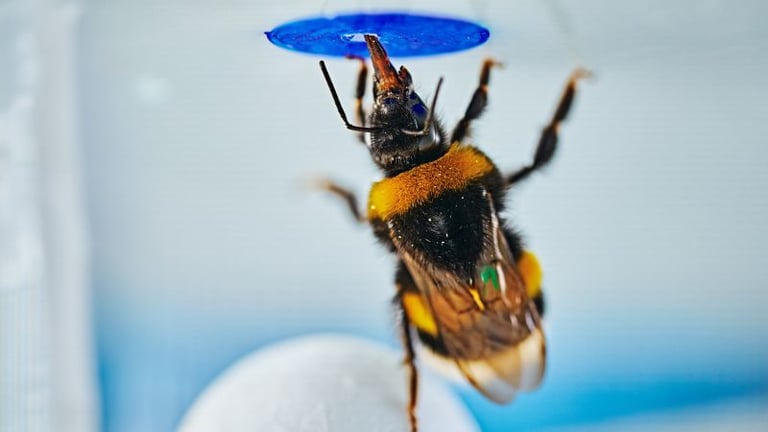

Bees solved a novel problem by rolling a foam ball under a blue artificial flower, climbing on it, and reaching a sugary reward without prior training, in a setup adapted from the classic box-and-banana puzzle.
Researchers caution that they are not claiming bees think like humans, but demonstrate that miniature brains can support adaptable, goal-directed behavior in surprising ways.
The study builds on evidence of cooperative problem-solving in bees and tests whether bees can independently solve a problem similar to the box-and-banana task.
Researchers acknowledge limitations, such as not tracking gaze or real-time cognitive processes, and call for further work to explore causal understanding and underlying cognitive mechanisms.
Experts James Nieh and Natalie Hempel de Ibarra highlighted the work’s significance for rethinking animal intelligence and the potential for flexible insect behavior.
The study by Dr. Olli Loukola and colleagues at the University of Oulu suggests insects may have more complex cognitive abilities and emotional states than commonly assumed.
While advising against overgeneralizing to human-like thinking, the researchers argue insects may belong in discussions of spontaneous cross-species problem-solving.
Findings are published in Science.
The work suggests cognitive abilities in bees that do not depend on large brains, given bees have about one million neurons versus humans’ roughly 86 billion.
Researchers note neuron count is not the sole determinant of cognition and consider ecological needs and brain-body size in interpreting results.
Independent experts, including Prof Lars Chittka, view this as the clearest demonstration yet of some comprehension and deliberate planning in bees, challenging the view that intelligent behavior requires large brains.
The researchers plan follow-up work to monitor physiological responses and determine whether bees experience an “aha” moment or understand the physical properties of objects involved.
Summary based on 6 sources
Get a daily email with more Science stories
Sources
Ars Technica • Jun 4, 2026
Bumblebees can spontaneously solve problems, study finds
CNN • Jun 4, 2026
Bumblebees show advanced problem-solving skills in new experiment
The Guardian • Jun 4, 2026
‘They surprise me every time’: bees can use tools to solve problems, study finds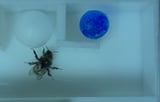
Scientific American • Jun 4, 2026
Bumblebees use tools to solve complex problems—despite not being trained to do so