Astronomers Spot Farthest Dormant Supermassive Black Hole, Unlocking Secrets of Early Universe Galaxies
June 5, 2026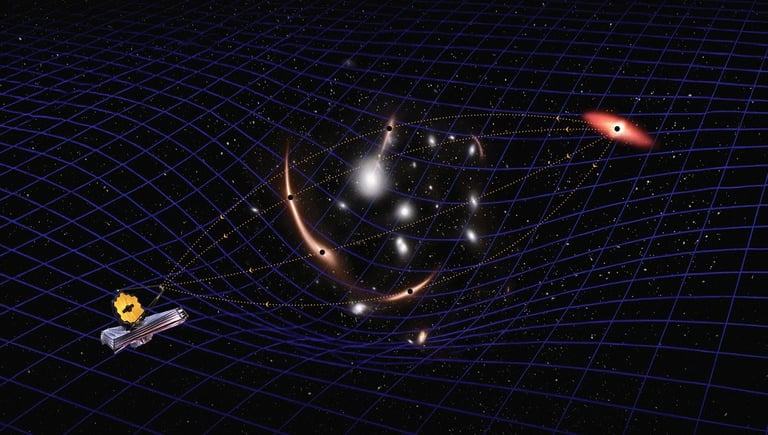

The method relies on stellar dynamics to weigh a black hole and represents a feasibility milestone for studying early-universe galaxies at great distances.
This work offers a new pathway to study quiescent, red-and-dead galaxies and the dormant black holes that may help quench star formation in their hosts.
Experts emphasize applying this approach to other distant galaxies could broaden understanding of black hole growth and their role in shaping galaxies across cosmic time.
The discovery was made possible by combining JWST’s infrared resolving power with gravitational lensing from a foreground galaxy cluster that magnifies and distorts light from MRG-M0138, enabling analysis of stellar dynamics near the hole.
The gravitationally lensed image of MRG-M0138 appears in three magnified copies, providing additional leverage for the measurements.
By enabling a census of red-and-dead galaxies, the technique could illuminate when and how black holes shut down star formation during a crucial epoch in cosmic history.
The host galaxy’s stars orbit the black hole at high velocities, highlighting the dynamic environment of this distant system.
This breakthrough enables a new census of black holes in the early universe and informs how they influence galaxy evolution over billions of years.
Looking ahead, researchers aim to apply the same approach to similar distant objects and leverage the Euclid mission to identify more gravitationally lensed candidates for broader population analyses.
A distant, dormant supermassive black hole in galaxy MRG-M0138 has been detected, marking the farthest such observation to date, more than 10 billion light-years away.
An international team measured this black hole’s mass at about six billion solar masses, with surrounding stars racing at roughly 400 km/s, far exceeding the Milky Way’s central black hole.
Gravitational lensing refracts and enlarges the light from MRG-M0138, allowing observations of stellar motions near the black hole despite the extreme distance.
Summary based on 2 sources
Get a daily email with more Science stories
Sources
Popular Science • Jun 5, 2026
JWST spots dormant black hole 10 billion light-years from Earth
IFLScience • Jun 5, 2026
JWST Measures Mass Of Most Distant Dormant Black Hole – Shattering Previous Record By 15 Times