Octopus-Inspired Robotic Arm Revolutionizes Underwater Tasks with Sensory-Enhanced Suction Cups
June 8, 2026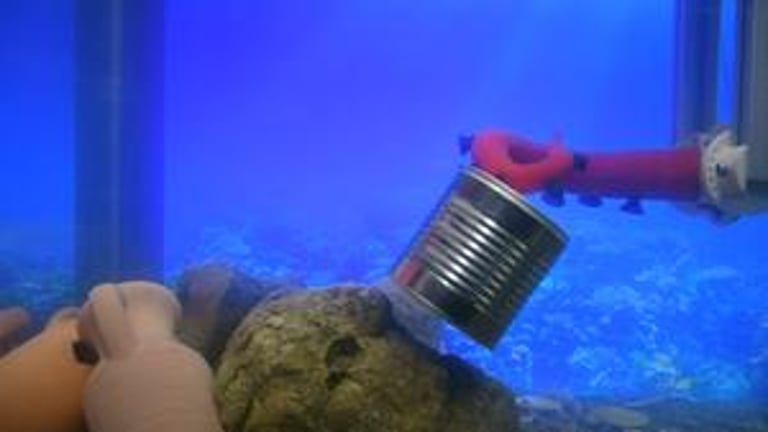

An octopus-inspired soft robotic arm from the Italian Institute of Technology’s Bioinspired Soft Robotics unit, led by Barbara Mazzolai, embeds tactile sensing directly into suction cups to enable contact detection, force estimation, and autonomous grasping in air and underwater.
Progress at IIT includes tendon-cable optimization models and 3D-printed soft endoskeletons, culminating in a sensory-integrated arm that links perception and action within its structure.
The work builds on IIT’s broader octopus-inspired robotics program, featuring computational tools for optimal cable arrangements in soft arms and manufacturable, 3D-printed endoskeleton pathways.
Potential applications span handling fragile objects and biological samples underwater, as well as inspection and maintenance tasks in hostile industrial and natural environments.
The design is modular, with adjustable suction-cup numbers and placements to suit different tasks, supporting marine biology research, subsea maintenance, and other underwater operations.
The system’s modular and scalable nature allows tailored grasp distribution and enhanced environmental perception for specific missions.
The research has broad implications for autonomous underwater vehicles and robotic manipulators, enabling precise, context-aware interactions in delicate or hazardous ecosystems and paving the way for multi-limbed platforms with distributed sensing.
The approach mirrors the octopus’ decentralized nervous system, enabling rapid, autonomous grip adjustments in challenging underwater settings and improved handling of delicate objects.
Lead author Emanuela Del Dottore emphasizes embedding sensing into the robot’s interface with the environment, signaling a move toward embodied autonomous systems with immediate motor responses to tactile input.
Future goals include increasing payload capacity, expanding grasp versatility to more underwater objects, and extending the approach to more complex environments for fully autonomous soft robotics.
Suction cups employ silicone cups with miniaturized optical tactile sensors that detect changes in reflected light to estimate contact force and direction, enabling distributed local sensing and peripheral control.
The arm uses miniaturized optical sensors inside suction cups, where deformation alters LED reflections to gauge force magnitude and direction, coordinated by a distributed control system.
Summary based on 2 sources
Get a daily email with more Science stories
Sources

EurekAlert! • Jun 8, 2026
From the ocean, the robotic arm inspired by the octopus
BIOENGINEER.ORG • Jun 8, 2026
From the Ocean Depths: Octopus-Inspired Robotic Arm Revolutionizes